
01
Four motors, a battery and a pair of goggles
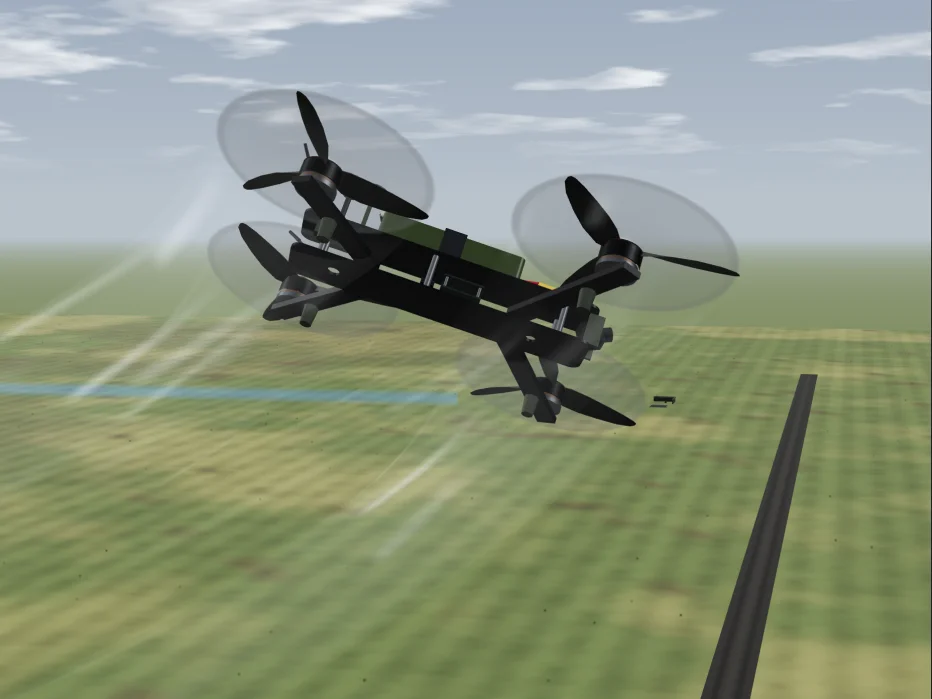
You are looking at an FPV drone: a small quadcopter flown by a pilot who wears goggles and sees through its camera. FPV stands for first-person view. This one is a 7-inch long-range model, named after its propellers: each is about 7.5 inches across, about 190 mm. The frame is carbon fibre, two plates and four arms. Without a battery it weighs 630 to 705 g; with one it comes to about 1 kg. A hobby version costs USD 550 to 950 without radio and goggles. Built in bulk for an army, the airframe comes to about USD 400 to 500.
Drones like this fly in large numbers in the war in Ukraine. Ukraine's defence ministry bought more than 1.5 million drones in 2024 and planned to buy 4.5 million FPV drones in 2025. In practice they work about 10 to 20 km from the pilot. Scout teams fly them to look at roads, fields and treelines, and that is what the drone in the model does: its payload is a camera, the pilot's eye.
The model follows one short reconnaissance sortie of 80 seconds. The pilot arms the drone beside a dugout, lifts off from a pad, climbs to 40 m and cruises out at 70 km/h. Over a crossroads 350 m away the drone circles one and a half times at 50 m, then flies home and lands on the pad. The distances are real metres, but a real sortie would be far longer. The drone is drawn ten times too big so you can still see it. Its speeds, heights and the battery it uses are the model's own choices, inside the ranges a real 7-inch quad flies.
The clock at the top counts real seconds since arming, so T+0:42 means 42 seconds into the flight. Drag the timeline to any moment, or tap a chip below to jump there. Watch the readouts as you go: speed, height, the battery voltage and how far the drone is from the pilot. The radio links switch draws the two beams between the drone and the pilot's station. The flight track switch draws the path behind the drone. The spin arrows switch shows which way each propeller turns, with its motor number.
02
No wings, no rudder: it steers with motor speed
A quadcopter has no wings, no rudder and no moving control surfaces at all. Every move it makes is a change in the speed of one or more motors. To hover, the four propellers together must push up with exactly the drone's weight. Each motor can give up to about 2 kg of thrust, so a 1.4 kg drone hovers on a small part of what it has. Thrust grows with the square of the propeller speed: double the speed and you get four times the push.
Look at the spin direction arrows: two propellers turn clockwise and two turn counter-clockwise, in diagonal pairs. There is a reason. A spinning propeller twists back on the drone. If all four spun the same way, the body would spin the other way. With two turning each way, the twists cancel. That also gives the pilot a way to turn: speed up one pair and slow the other, and the twists no longer cancel. The drone turns about its vertical axis, the opposite way to the faster pair. Pilots call this yaw.
To tilt, the drone speeds up one side and slows the other. Speed up the two rear motors and the nose dips; that is pitch. Speed up the left pair and the drone leans right; that is roll. The total thrust stays the same, but now it points at an angle, so part of it pushes sideways. That is how a quad moves: it tilts, and the tilted thrust drags it along. Tap the chips to see which motors speed up for each move. The rear motors are numbers 1 and 3, as the flight control software Betaflight counts them.
The slider shows what a tilt does. Tilt the drone 30 degrees and it pushes sideways with about 0.58 of gravity, close to 5.7 m/s². To hold its height at the same time it needs about 15 % more thrust than in a hover, because only part of the thrust still points up. At 45 degrees the push equals gravity and the thrust must rise by 41 %. Freestyle quads carry about four to five times their weight in thrust, so they hover at about 20 to 25 % throttle and keep plenty for a climb or a sprint. Long-range quads carry less because a bigger battery weighs them down: this one has about 5.7 to 1, and heavy-lift builds go as low as 2 to 1.
03
A thousand corrections a second
A quad cannot balance on its own, and no human can react fast enough to balance it by hand. The flight controller, a small board in the stack between the plates, does it. Its gyroscope measures how fast the drone is rotating about each axis 8,000 times a second. A control loop called PID compares that with what the pilot asks for and corrects the four motor speeds, 4,000 or 8,000 times a second. P pushes toward the asked-for rate, I removes slow drift, D damps the fast wobbles. Several thousand corrections a second, every second of the flight.
Under the flight controller sits the ESC, the electronic speed controller: four in one board, rated 50 to 55 A per motor. It turns each new throttle value into timed pulses for the three windings of its motor. The two boards talk over DShot, a digital protocol: one 16-bit word per motor, 11 bits of throttle, a telemetry bit and a checksum, sent in 27 microseconds at 600 kilobits a second. With bidirectional DShot the ESC also reports the real motor speed back, so the controller can filter out the vibration each propeller makes.
What do the sticks command? In acro mode, the default, each stick commands a rotation rate. Push the roll stick halfway and the drone rolls at a steady rate; centre it and the drone stops rolling and holds the angle it has reached, even upside down. By default, full stick asks for about 670 degrees a second, almost two full rolls. Angle mode is for beginners: the stick sets a tilt angle, and the drone levels itself when you let go. Most FPV pilots fly acro, from racers to freestyle pilots: it gives full control in wind and lets the drone take any attitude. Tap the chips to compare the three modes.
Two safety features matter. A switch on the radio arms the drone, which starts the motors and the stabilisation; the controller refuses to arm if the throttle is up or the drone is tilted too far. If the radio packets stop, the failsafe waits 1.5 seconds, then by default cuts the motors and the drone drops. The GPS module on its mast is optional. Betaflight flies without it. With it, GPS Rescue can fly the drone back toward where it was armed when the link is lost, but it is an emergency aid, not a return to home: the pilot must take back control, or it crashes.
How a stick move reaches the propellers
- Radio: the pilot moves a stick; the radio reads it and sends a packet, 250 times a second in the model.
- Receiver antenna: the receiver on the drone decodes the packet and hands the stick values to the flight controller.
- Gyro: the flight controller reads how fast the drone is turning, 8,000 times a second.
- PID loop: it compares the asked-for rate with the measured one and works out four new throttle values.
- ESC: each value goes out as a 16-bit DShot word in 27 microseconds, and the ESC times the pulses to the motor.
- Propellers: the motor speeds change, the thrusts change, and the drone tilts, turns or climbs.
04
Two radios: one to steer, one to see
Two radio links run between the pilot's station and the drone. The control link carries the stick positions out. In the model it is ExpressLRS, an open-source system that works on 900 MHz or 2.4 GHz. It sends small packets at a fixed rate, 50 to 1,000 times a second on 2.4 GHz. Slower packets reach farther: the receiver can listen longer for each one and still decode a weaker signal. At 50 Hz it hears signals down to −115 dBm, at 500 Hz only down to −105 dBm. That difference of 10 dB is about 3.2 times the reach in open air. Flown at a low rate, in line of sight from a height, a single 2.4 GHz link has reached over 100 km.
The video link comes back the other way, from the video antenna at the rear. Analogue video on 5.8 GHz is the classic choice: 40 channels in five bands, a standard-definition picture that fades gracefully into snow as the drone gets far away, and a delay of about 20 to 30 ms from camera to eye. Digital systems send a 1080p picture at 100 frames a second with a delay of about 20 ms, and the best units are rated for 10 to 15 km. But good analogue is still the lowest-latency option, and it degrades gently instead of freezing. Tap the chips to compare.
Both links use circular polarised antennas: the wave turns as it travels. A reflection off the ground or a wall flips the turning direction, so the antenna rejects most of the bounced signal that would otherwise smear the picture. The goggles put two small 1080p screens in front of the pilot's eyes, with a field of view of 44 to 46 degrees. A field team usually adds a second screen so a navigator can watch too, puts the radio antenna on a mast, and sometimes flies a second drone high up as a repeater to carry the links over a ridge. Some FPV drones trade both radios for a thin optical fibre unwound from a spool of 10 to 20 km: with no radio link, there is nothing to jam.
Use the second chip row to change the packet rate and watch three numbers move: the time between packets, the weakest signal the receiver still hears and the reach compared with 500 Hz. The readouts below follow the model: the distance from the pilot and how strong the control link is. In this short sortie the drone never gets farther than about 400 m, so the link stays strong. Real teams work at 10 to 20 km, where the packet rate, the antennas and a clear line of sight decide whether the picture holds. Radio power is the last lever, not the first.
05
Twelve minutes in the air
The battery on the top plate is a 6S pack: six lithium cells in series. With LiPo cells that is 22.2 V nominal and 25.2 V full. The Li-ion pack in the model is 21.6 V nominal and 25.2 V full. Pilots land at about 3.5 V a cell, 21 V for the pack, and never go below 3 V a cell, where the cells take damage. This pack holds 4,200 mAh, about 91 Wh, and weighs about 450 g. A battery's C rating says how much current it can give as a multiple of its capacity: a 1,800 mAh LiPo rated 95C could in theory deliver 171 A, while a Li-ion cell manages 30 to 45 A.
Why Li-ion for long range? Energy per kilogram. A 6S 1,800 mAh LiPo stores 40 Wh in 288 g, about 139 Wh/kg. The Li-ion pack stores 91 Wh in 450 g, about 200 Wh/kg, roughly 45 % more. The price is current: Li-ion cells cannot deliver the bursts a racing quad wants, which is fine for a scout that cruises. And cruising is where the energy goes furthest. Hovering costs more power than flying forward at a moderate speed, because propellers work better in moving air. Long-range pilots plan routes that keep the drone moving and hover as little as possible.
Drag the slider to load the drone. Each extra 100 g raises the all-up weight, lowers the thrust-to-weight ratio, raises the throttle needed to hover and cuts the flight time. The model takes 80 % of the pack's energy as usable and divides it by the power needed to cruise at that weight, which gives about 12 minutes with the camera on board. A bigger battery does not fix this for long: more battery means more weight, which means more power to carry it, so each extra pack gives less than the last. Real 7-inch long-range quads fly 12 to 30 minutes; a 5-inch freestyle quad on a small LiPo manages about 4 to 6.
Watch the voltage during the flight. It sags under load, because current through the pack's internal resistance costs volts, and it recovers when the drone eases off: a 6S can show 21 V in a hard climb and 23 V in a hover. Cold makes this worse. At minus 20 °C a lithium cell keeps only about 65 % of its capacity, and its resistance rises, so the low-voltage warning comes early. Pilots keep their packs warm until launch. The readouts below show the pack's voltage and current as the model flies the sortie, and the battery gauge at the top fills from them.
06
Fast, cheap and everywhere
You are now looking through the pilot's goggles: this is the picture from the drone's own camera on its way home. How fast can it go? A 7-inch long-range quad like this one tops out at about 140 km/h and cruises at 60 to 80 km/h. Racing quads are quicker: the Drone Racing League's RacerX set an official 263 km/h in 2017. The record is in another world. On 11 December 2025 the Peregreen V4, built by Luke and Mike Bell in South Africa, set a Guinness record of 657.59 km/h for a battery-powered quadcopter. It is a purpose-built machine, nothing like a typical FPV drone. Tap the chips to see how long each would take to cover the 350 m to the crossroads.
Wind is the real limit in the field. A rule of thumb says to fly only when the wind is below two thirds of the drone's top speed, and quads this size handle about 32 to 40 km/h of steady wind. Every gust costs battery, because the drone has to tilt into it and the tilted thrust takes more power. This is also where an FPV quad differs from a camera drone such as a Mavic. A Mavic holds its position with GPS and a barometer when you let go of the sticks. An FPV quad in acro holds only its attitude and drifts with the wind. Nothing stops it but the pilot.
That makes it hard to learn. Most new pilots crash repeatedly in their first hours, so they start in a simulator: 20 to 60 hours in a program such as Velocidrone or Liftoff before the first real flight is common advice. The first pilots to fly with goggles did so around 2007, as a hobby, and racing followed. The first world championship was flown in Shenzhen in 2018 by 128 pilots from 34 countries, and a 15-year-old won it.
Cheap and simple is why these drones are everywhere. A hobby quad costs USD 550 to 950 without radio and goggles; a frame kit alone is about USD 130 to 150. Built by the thousand for an army, the airframe comes to about USD 400 to 500, and Ukraine planned to buy 4.5 million FPV drones in 2025. In practice they work about 10 to 20 km from the pilot. To reach farther, teams fly a repeater on a second drone: one Ukrainian system rides a larger drone at 500 m, stays up for an hour and relays signals up to 30 km. The pilot's station in the model is far simpler: a dugout, a case, a mast with an antenna, and a pilot in goggles.