
01
The fan and the two streams
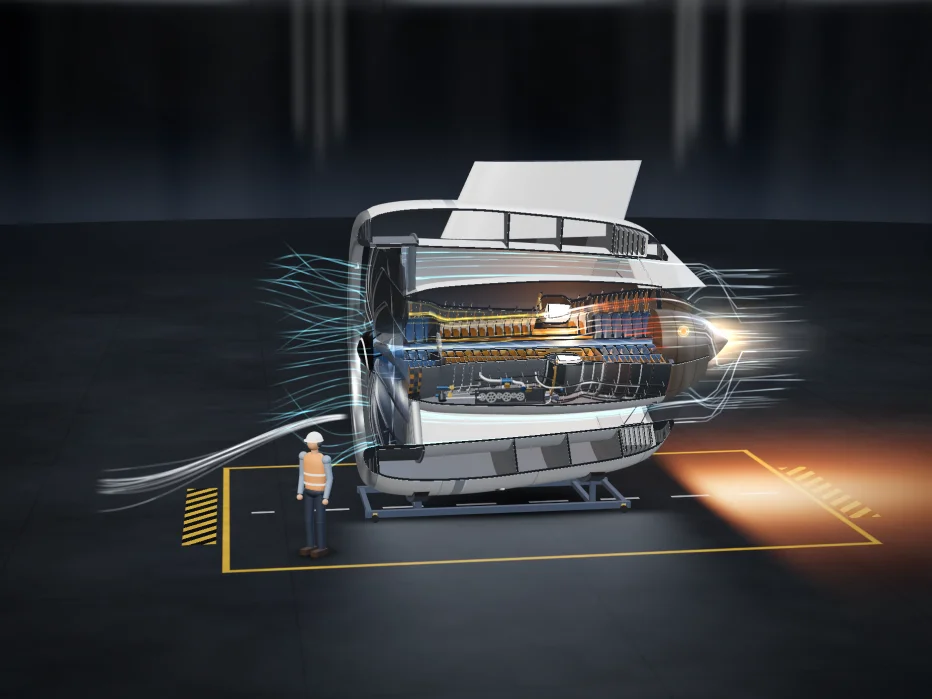
Stand in front of the engine and look in. The first thing the air meets is the fan, a ring of 16 big blades made of carbon fiber. It is 3.4 meters wide, nearly as wide as the body of a Boeing 737. The small figure beside it is 1.8 meters tall. No other airliner engine has a fan this big.
Just behind the fan, the air meets a sharp edge called the splitter. It splits the air in two. About 10 of every 11 parts go around the middle of the engine, which is called the core. This is the cold stream, and it goes straight out of the back. The other part, about 1 in 11, goes into the core. This is the hot stream, and you will follow it through the next chapters.
Which stream does the pushing? Most of the push comes from the fan. Engineers call this push thrust. The fan grabs a huge amount of air and throws it back a little faster. Pushing a lot of air a little is a good way to push a plane. By the numbers GE gives, the blade tips move faster than sound at full power.
Pick Cold or Hot to look at one stream at a time. The model draws the air as long lines with dashes moving along them. The lines split at the splitter, and most of them go around the core. The number of lines does not show the 10 to 1 split. The speeds and colors are the model's picture, not measurements. The model is drawn to show how the engine works, not to be measured. Its layout is its own, and so are the blade counts, except for the 16 fan blades.
This engine is made for the Boeing 777-9, which is not in service yet. Its first delivery is targeted for 2027. The engine itself is certified, and it flies on test airplanes.
- Fan blades
- 16, carbon fiber
- Fan width
- 3.4 m, nearly as wide as the body of a 737
- Air that goes around the core
- about 10 of every 11 parts
- Blade tips at full power
- faster than sound
02
The squeeze
Now follow the core air. First it passes the booster, three stages of small blades right behind the fan. Then it enters the compressor, which has 11 stages. A stage is one ring of spinning blades and one ring of fixed blades. The spinning ring pushes the air on. The fixed ring sets it up for the next stage.
Each stage squeezes the air a little more. On the core path, the lines squeeze together and turn warmer in color. The compressor alone squeezes it 27 to 1, which means 27 times the pressure. Counting the fan and the booster, the whole engine squeezes it to above 60 to 1. GE says that is the highest of any engine in service. Squeezed air burns well, so it gives more power for each drop of fuel.
The compressor spins on the outer shaft, a hollow tube. The high pressure turbine, a wheel of blades at the back, turns it. Colors show who turns what. Everything on the outer shaft is bronze: the compressor and the high pressure turbine. Everything on the inner shaft is blue: the fan, the booster and the low pressure turbine. Parts that stand still are grey. Stripes on the shafts and marks on the discs show the bronze core turning several times faster than the blue fan shaft. Published speeds differ, so the model uses its own. It also turns the shafts many times slower than the real engine, so you can see the blades.
Pick Cutaway to see inside, then drag the marker on the time bar. The marker shows where two parcels of air are: one in the core and one in the cold stream. The bar names the steps of the core air: suck, squeeze, burn, spin and blow. The cold air skips squeeze, burn and spin, because it flies along the duct around the core. The number shows the meters from the intake lip, the front edge of the engine.
- Compressor stages
- 11
- Squeeze in the compressor
- 27 to 1
- Squeeze in the whole engine
- above 60 to 1
- Driven by
- the high pressure turbine, on the outer shaft
03
Where the fuel burns
The squeezed air now enters the combustor, where the fuel burns. First a part called the diffuser slows the air down. Then fuel is sprayed in through small nozzles. It burns steadily, like a gas stove, not in bangs. In the model, the lines of air flare bright here.
This engine mixes the fuel and the air first, and burns the mix after that. Engineers call this lean burn: a lot of air for a little fuel. A mix like this burns cleaner. GE says the engine makes less than half of the nitrogen oxides, a polluting gas, that the latest limit allows.
The walls of the combustor are called liners, and here they are made of ceramic. This ceramic is about one third as dense as metal alloys, so it is lighter. It also needs less cooling air.
The glow and the colors of the lines are only a picture. GE does not publish the gas temperature, so the model just draws hotter as brighter. Pick Cutaway to look inside. This fire does not push the plane. Its job is to heat the air, and the next chapter shows why.
- Burning style
- lean burn, fuel and air mixed first
- Liners
- ceramic
- Nitrogen oxides
- less than half of the latest limit, GE says
- Ceramic is lighter
- about one third the density of metal alloys
04
Two turbines, two shafts
Hot, fast gas leaves the combustor and meets the turbines. A turbine works like a windmill: the gas pushes the blades round. This is what the fire is for. It does not push the plane. It heats the air so that the turbines can spin. As the gas spins them, the lines of air spread, cool and twist.
There are two turbines, on two shafts. The high pressure turbine comes first. It has 2 stages, and it drives the compressor through the outer shaft. The low pressure turbine comes next. It has 6 stages, and it drives the fan and the booster through the inner shaft, which runs inside the outer one. The colors show who drives what: the bronze high pressure turbine drives the bronze compressor, and the blue low pressure turbine drives the blue fan and booster.
The two shafts turn at different speeds. The core shaft turns several times faster than the fan shaft. Published figures for the exact speeds differ, so the model uses its own. The spin, the stripes on the shafts and the glow in the animation are the model's too. The two live readouts below are percentages of the model's takeoff setting, not turns per minute.
Hot gas is hard on metal blades. They survive on cooling air and coatings, and this engine adds ceramic parts. There are five kinds of ceramic part. About 300 parts are 3D printed, in seven kinds. GE does not publish the gas temperature, so you will not find one here.
- High pressure turbine
- 2 stages, drives the compressor
- Low pressure turbine
- 6 stages, drives the fan and booster
- Ceramic parts
- five kinds
- 3D printed parts
- about 300, in seven kinds
- Fan speed
- 80 %
- Core speed
- 87 %
05
Where the thrust comes from
At the back there are two nozzles. The cold stream comes out of the wide one around the core. The hot stream comes out of the narrow one in the middle. The cold stream is about 10 parts of air, wide and slow. The hot stream is 1 part, narrow and fast. Faster dashes mean faster air. The model shows the speeds as relative, not in meters per second.
Which is better: a lot of air pushed a little, or a little air pushed a lot? A lot of air pushed a little wins. It wastes less energy, so it uses less fuel. This is why modern airliner engines have such big fans. GE says this engine burns up to 10 percent less fuel for the same thrust than its older engine, the GE90-115B.
Now the numbers. At takeoff, GE rates the engine at about 105,000 pounds of thrust, around 470 kilonewtons. A kilonewton is a thousand newtons, a unit of force. The engine reached a test record of 134,300 pounds, which Guinness recognized in July 2019. That was a test, not a normal flight. For comparison, the engine of a 737 Next Generation makes about 92 to 121 kilonewtons.
Move the thrust lever in the gauge and watch the streams change. At a high setting, the model pulls the air harder into the intake, and the exhaust plume grows longer and brighter. The thrust readout is the model's estimate, as a percent of its takeoff setting. The model also has its own split of the push between the two streams. It is a sketch, because GE does not publish one. All we can say is that most of the push comes from the fan.
- Cold stream
- about 10 parts, wide and slow
- Hot stream
- 1 part, narrow and fast
- Takeoff rating
- about 105,000 pounds, around 470 kN, GE says
- Test record
- 134,300 pounds, recognized July 2019
06
Starting and reversing
Before a start, the core is still. To get it turning, an air turbine starter uses compressed air. The air can come from a small engine in the plane called the APU, from a ground cart or from the other engine. The starter turns the core shaft through a small gearbox and a drive shaft. This is the only gearbox: nothing sits between the turbine and the fan, because the fan is driven directly. Then fuel and fire join in, and the turbines take over. The details of a real start are not published, so the model skips them. The gearbox position, like the pipes and fittings on the core, is the model's own layout, not GE's drawing. Pick Starter below to see the gearbox and the starter.
After landing, the engine has a second job: slowing the plane down. A thrust reverser turns some of the air forward. Then the engine pushes the plane backward instead of forward. In an engine like this, the reverser turns only the cold stream, and the model shows it that way. GE has not confirmed this for the GE9X, so take it as the model's picture.
In the model, the reverser moves part by part, like a real mechanism. First the rear part of the nacelle slides back. Then doors swing down and block the path around the core. This uncovers a band of small curved vanes called cascades. The cold lines turn out and forward through them, while the hot stream keeps going straight back. This chapter starts with the reverser out. Stow it and deploy it again to compare, or press D, and watch the thrust readout drop below zero. It then says Reverse, with a percent. The model limits the engine power while the reverser is open. The size of the reverse push and the timing of the movement are its own choices, because no figures are published.
This engine has not carried passengers yet. The Boeing 777-9 is not in service yet, and its first delivery is targeted for 2027. Until then, only test airplanes fly with it.
- Thrust, model estimate
- Reverse 10 %
- What turns
- the cold stream, in the model
- In service
- the 777-9 first delivery is targeted for 2027