
01
One engine, one loop of teeth
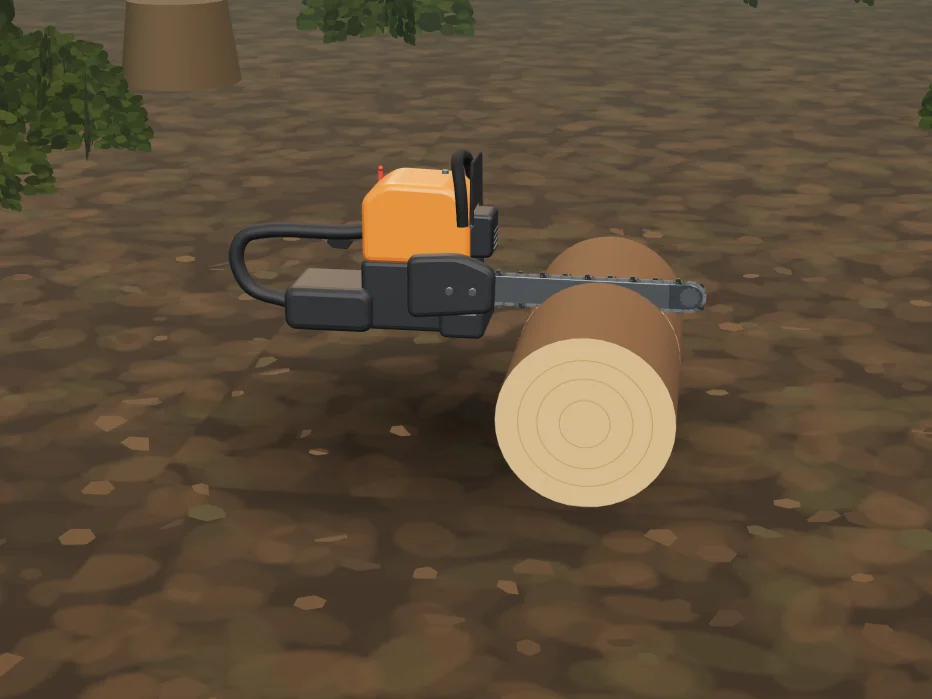
This is a chainsaw, a professional saw like the Husqvarna 572 XP. Its engine sits inside the orange engine housing. A flat steel guide bar sticks out 40 cm in front. A loop of sharp teeth, the saw chain, runs round its edge. Your right hand holds the rear handle and squeezes the throttle trigger. Your left hand holds the front handle, just behind the front hand guard.
An engine's size is the space its piston sweeps, measured in cubic centimetres (cm³). A homeowner's saw has about 30 to 50 cm³ and makes 1.4 to 2.4 kilowatts (kW) of power. A professional saw like this one has about 70 to 80 cm³ and makes 4.3 to 5 kW. Yet it weighs only a little more: 6.6 kg without its bar and chain. Saws were not always this light. Stihl's gasoline saw of 1929 weighed 46 kg and needed two people. Only around 1950 did gasoline saws become light enough for one.
This page follows one turn of the crankshaft, the shaft the engine spins. At full power it turns about 9,900 times a minute. That is 9,900 rpm, revolutions per minute. So one turn takes about 6 ms, six thousandths of a second. On a screen, that is just a blur. So the model plays the turn 64 to 2,048 times slower than life. You can change how slow under Playback.
Here is the story of one turn. A spark fires, and burning gas pushes the piston down. The piston turns the crankshaft, and the crankshaft turns the clutch. The clutch turns a toothed wheel, and the wheel pulls the chain. Each tooth on the chain takes a chip of wood. Drag the throttle slider and watch the chain speed follow. The model keeps this simple: the engine speed follows the throttle in a straight line, from idle to full power. On a real saw, the speed also rises and falls with the cut.
- Engine size
- 70.6 cm³
- Power
- 4.3 kW
- Weight
- 6.6 kg without bar and chain
- Guide bar
- 40 cm
02
One spark every turn
The engine is a two-stroke. A stroke is one trip of the piston, up or down. A two-stroke does all its work in just two strokes, which is one turn of the crankshaft. So the spark plug fires once every turn.
The piston does two jobs at once. Its top works in the cylinder, where the fuel burns. Its underside pumps the crankcase, the closed box round the crankshaft below. As the piston rises, the crankcase gets bigger and draws in fresh mixture, fuel and air mixed together. As the piston falls, the crankcase gets smaller and squeezes that mixture.
Follow the turn on the coloured bar under the model. Near the top, the spark lights the squeezed mixture. The burning gas pushes the piston down. The connecting rod turns that push into a spin. This is the power stroke. On the way down, the piston uncovers openings in the cylinder wall, called ports. The exhaust port opens first, and the burnt gas rushes out to the muffler.
A moment later, the transfer ports open too. They are channels that lead up from the crankcase. The squeezed fresh mixture flows up through them. It sweeps the last burnt gas out of the exhaust port. This is called scavenging. On the way back up, the ports close and the piston squeezes the new mixture. At the same time, underneath, the crankcase draws the next mixture in through the intake.
At 9,900 rpm, the spark fires 165 times a second. It jumps a gap of 0.5 mm between the plug's two tips. Makers do not publish exactly when the ports open or when the spark fires. So the model's timing is its own, and the bar shows how far into the turn you are, not an exact angle. Cutaway (C) opens the engine. Gas and oil flow (F) shows where the gases go.
- One turn takes
- 6.1 ms
- Power strokes a second
- 165
- In the cylinder now
- The piston squeezes the mixture and the crankcase fills
- Spark plug gap
- 0.5 mm
03
Fuel that runs at any angle
Most saws mix their fuel and air in a carburettor. Air comes in through the air filter, and the carburettor adds a fine spray of fuel to it. The throttle valve is a small flap that the trigger turns. It sets how much mixture can flow into the engine. Pick Idle, Half or Full and watch the flap open.
On a cold morning, the choke closes off some of the air. That makes the mixture richer in fuel, so the cold engine starts more easily. Once the engine runs, you open the choke again. The fuel itself waits in the fuel tank under the rear handle.
You hold a saw at every angle, even on its side. Many engines measure their fuel with a float in a small bowl, and that only works upright. A saw's carburettor uses a diaphragm instead, a thin flexible sheet. A small pump feeds it fuel, and the crankcase itself drives the pump. Every turn, the pressure in the crankcase rises and falls. The pulse line carries that beat to the pump. That is why the engine keeps running at any angle.
A two-stroke has no pool of oil under its crankshaft. Its oil travels with the fuel instead. You mix two-stroke oil into the gasoline at 50 to 1: 100 ml of oil in 5 litres of gasoline. On its way through the engine, the oil keeps the moving parts slippery. Not every saw has a carburettor, though. Some professional saws use electronic fuel injection instead.
- Throttle
- 0 %
- Fuel to oil
- 50 to 1
- Oil dose
- 100 ml in 5 l
- Crankcase now
- Drawing mixture in
04
Waking the engine up
To start a saw, you turn its engine by hand until it fires. Put the saw on the ground, at least 3 m from where you filled it. Both tank caps sit low on its left side: the fuel cap at the back, the bar oil cap at the front. Hold the front handle with your left hand and put your right foot in the rear handle. Then push the front hand guard forward to set the chain brake, every time. You start with the throttle held a little open. That is enough for the clutch to grip, so without the brake the chain would run.
A cold engine needs help. The choke lever closes the choke and sets that slightly open throttle. Bigger saws also have a decompression valve. Pressed in, it lets a little of the squeezed air out of the cylinder, so the cord pulls more easily. It closes by itself the moment the engine fires. Then you press the primer bulb about 6 times, or at least 10 on some saws. It does not squirt fuel into the cylinder. It pushes air out of the fuel line and draws fuel up to the carburettor.
Now take the starter grip. Its starter cord is wound on a rope pulley. Small hooks called pawls lock the pulley to the flywheel, a wheel on the end of the crankshaft. Pull slowly until you feel them catch, then pull fast. Each pull turns the crank a few times. Never wrap the cord round your hand, and never pull it out to its end. Do not let it snap back either: guide it in while a spring rewinds it. And never drop-start a saw, pushing it away from you as you pull.
The flywheel does more than spin. Its vanes are the fan that cools the engine. Magnets in it sweep past the ignition coil, just 0.25 mm away, and make the spark. So the saw needs no battery. Pick Start a cold saw to watch a whole start. The first pull ends in a pop: the engine fires once and stops. That pop tells you to switch the choke off, because a saw never runs on full choke. If you keep pulling on full choke after the pop, you flood the engine with fuel.
The second pull starts the engine at fast idle, a little faster than normal idle, with the brake still on. Blip the throttle trigger, and the engine drops to idle. Only then do you release the brake. If the chain still turns at idle, the saw needs adjusting. The model shows the steps, not their real timing. The pull plays at a pace you can follow, and the slow motion begins once the engine runs. Makers do not publish how fast a pull turns the engine, or the fast idle speed, so the gauge shows words there. Cutaway (C) takes the starter cover off, and the coil gap is drawn wider than life so you can see it.
- Now
- Cold and stopped
- Engine
- Stopped
- Primer bulb
- about 6 presses, at least 10 on some saws
- Gap between magnet and coil
- 0.25 mm
- Start away from where you fuelled
- at least 3 m
05
Why the chain stops at idle
Between the crankshaft and the chain sits a centrifugal clutch, a clutch that works by spinning. Its weights, the clutch shoes, spin with the crankshaft, and springs hold them in. Around them is a steel cup, the clutch drum. The drum carries the sprocket, the toothed wheel that drives the chain. As the engine speeds up, the spin flings the shoes outward against the drum. Friction then makes the drum turn with them.
At idle, about 2,700 rpm, the springs win and the shoes stay in. The drum stands still, so the chain does not move. That is how it should be: at idle, the chain must not run. On this saw, the shoes grip at 3,700 rpm. Drag the throttle slowly past that point and watch the chain start. In the model, the clutch grips fully the instant the engine passes 3,700 rpm, so the chain jumps straight to about 8 m/s. A real clutch slips for a moment as the shoes bite.
The sprocket has 7 teeth, and each one moves the chain by two pitches. A pitch is the gap from one rivet in the chain to the next. So one turn moves the chain about 133 mm. At 9,900 rpm, that works out to 22 metres per second (m/s), about 79 km/h. The maker's own figure for a saw like this is about 21 m/s. At this speed the engine makes its full power, and while cutting it runs close to it. With nothing to cut, a saw can spin faster, up to a built-in limit of 12,500 to 14,000 rpm.
This is why, as you saw when starting the saw, the chain brake goes on first: the start setting spins the engine fast enough for the clutch to grip. If the chain is held still while the engine races, the clutch slips and gets very hot. The oil pump sends oil to the bar only while the chain runs. At idle, no oil flows.
- Idle speed
- 2,700 rpm
- Clutch grips at
- 3,700 rpm
- Chain moved per turn
- 133 mm, 7 teeth × 2 pitches
- Oil pump
- Stopped
06
Teeth that take chips
A saw chain is built from three kinds of parts. Drive links hang down into a groove in the bar, and the sprocket's teeth push them along. Cutters are the teeth, one leaning left, the next leaning right. Small plates called tie straps join them, held together by rivets.
Each cutter has a flat top plate and a side plate. Where they meet is a sharp corner that slices the wood. Just in front of each cutter stands a small hump, the depth gauge. It sits 0.65 mm lower than the cutter's top. That gap sets how thick a chip the cutter can take. File the depth gauges too low and the cutters bite too deep, which makes kickback more likely.
A chain's size is its pitch. To measure it, take the distance across three rivets in a row and halve it. This chain has a 3/8 inch pitch, 9.525 mm. A chain like this one on a 40 cm bar has 55 drive links and is about 1.05 m long. It carries about 27 cutters, one for every two drive links.
At 9,900 rpm, the chain moves 22 m/s. That means about 570 cutters pass any one point every second, and each takes a chip. Pick Idle, Half or Full to compare. In the cut, the chain under the bar runs back from the bar nose toward the saw. That is why the chips fly out behind the cut.
All this time, the chain slides along the steel bar at full speed. Without oil, the rubbing would soon make the bar burning hot. So the oil pump drips bar oil onto the chain, and the chain carries it round the bar. On a small Stihl saw, the bar oil runs out at about the same time as the fuel. So you can fill both tanks together.
- Chain speed
- 22.0 m/s, 79 km/h
- Cutters past one point each second
- 570
- Pitch
- 3/8 in, 9.525 mm
- Links
- 55 drive links, 27 cutters
- Chain length
- about 1.05 m
- Depth gauge below the cutter
- 0.65 mm
07
The upper quarter of the nose
The most dangerous part of a saw is the top quarter of the bar nose, the kickback zone. Kickback zone (K) paints it red. If the moving chain touches wood there, the cutters can catch. The bar is then flung up and back toward you in a flash. This is kickback. Measurements show a gasoline saw can spin at over 1,000° a second.
A person needs about 0.1 to 0.2 s to react. By then, the bar can already have swung far enough to reach you. So reflexes alone cannot save you. Kickback has two cousins too. If the chain on the bottom of the bar snags, pull-in drags the saw forward. If the chain on top snags, pushback drives the saw straight back.
The chain brake is the answer. A steel brake band wraps round the clutch drum. When your left hand pushes the front hand guard forward, a spring snaps the band tight. The band grips the drum, and the chain stops within a fraction of a second. In a strong kickback, the guard can trip by itself. The saw flips up, but the guard keeps moving by inertia, the way a moving thing tends to keep going. So it swings forward. This is the inertia brake.
Pick Show a kickback to see a strong one, slowed down and smaller than life. Watch the guard snap forward and the band clamp the drum. In the model, the chain stops at once. Not every kickback trips the brake on its own, though. A milder one may need your hand. The brake lowers the risk, but it cannot stop the kickback itself. The chain catcher, a hook under the bar, catches a chain that breaks or jumps off. Low-kickback chain, sold with a green label in North America, lowers the risk too.
In the United States in 1979, kickback caused nearly one in four chainsaw injuries. Today, about 70 people a day still go to emergency rooms there with chainsaw injuries. A saw is also loud. At your ear it reaches about 104 to 107 decibels, written dB(A), the unit of loudness. Without hearing protection, 107 dB(A) is safe for only about 3 minutes a day. So wear ear protection, keep both hands on the saw and keep the nose clear.
- Chain brake
- Off, chain free
- Kickback spin
- over 1,000° a second
- Time a person needs to react
- about 0.1 to 0.2 s
- Chain brake stops the chain
- within a fraction of a second
- Injuries caused by kickback
- nearly 1 in 4, US, 1979