
01
Flying with no engine
You are looking at a glider, also called a sailplane. It has long wings, a stick and pedals like an aeroplane, but no engine. A winch or a tow plane launches it to between 300 and 1200 m up, and from then on it is on its own. With nothing to push it along, it is always sinking through the air, just slowly.
So the only way up is air that rises faster than the glider sinks. In calm air a modern glider sinks as little as 0.5 m/s, so air rising at 2 m/s carries it up at 1.5 m/s. Pilots find rising air over sun-warmed ground, on windy mountain slopes and in waves downwind of mountains. Hopping from one to the next, a glider can go a very long way: the world record for free distance is 3,009 km.
The model flies one 45-minute loop as a time-lapse. The glider climbs in a thermal over a warm field up to a cloud, glides to a mountain ridge, climbs along the ridge and then in the wave above it, and races home. The scene is squeezed and the glider drawn far larger than life, but the heights, speeds and climb rates in the readouts are real. Heights count from the valley floor.
Drag the model to look around it and scroll over it to zoom. As you read on, the view follows the text.
02
Why it does not fall
A glider in flight feels three forces, drawn as arrows in the scene. Weight pulls it straight down. Drag, the push of the air, holds it back. The model draws the drag arrow far longer than it really is so you can see it: at 1 : 50, drag is only a fiftieth of the weight. Lift comes from the wings. Each wing meets the air at a small angle and turns it downward, and as the wing pushes air down, the air pushes the wing up. The air over the top also speeds up, so the pressure above the wing is lower than below it. These are two views of the same effect.
With no engine, the glider flies a gentle downhill slope. Because its path tilts down, a small part of its weight pulls it forward along the path. Gravity is its engine, and height is its fuel. How far it goes for the height it loses is its glide ratio. At 1 : 50 it travels 50 m forward for every metre down, so from 1000 m up in still air it covers 50 km.
Choose a glider above. The trainer is a Schleicher ASK 21, a two-seater with 17 m wings, and it glides at 1 : 34. The racers are the Jonker JS3 with 15 m or 18 m wings, at 1 : 50 and 1 : 57. Long, slender wings are the secret: they make lift with very little drag. For comparison, a big airliner manages roughly 1 : 15 to 1 : 20, a hang glider about 1 : 15 and a paraglider about 1 : 10.
Now move the airspeed slider. A JS3 glides best between about 105 and 120 km/h, near the low end when it is light. Weight does not change the slope: with up to about 200 L of water in its wings, it glides the same slope, only faster, near the high end. Fly faster still and the ratio falls, because the sink rate grows faster than the speed. Even so, the 18 m JS3 sinks only about 1.4 m/s at 200 km/h, which is still 1 : 40.
03
Warm air rises
The sun does not heat the ground evenly. Dark fields, towns and slopes facing the sun warm up faster than grass or wet ground, and they warm the air above them. Warm air is lighter than the cooler air around it, so it breaks away and rises, as a steady column or a string of bubbles. Glider pilots call this rising air a thermal.
A thermal is typically 150 to 300 m across. It rises fastest in the middle and leans over with the wind. Under 1 m/s is a weak thermal, 1 to 2.5 m/s is average and 3 m/s or more is strong. Ours rises at about 2.7 m/s over the dark field, leaning toward the ridge.
To stay inside, the pilot circles, banked at about 45° at 90 km/h. One circle takes about 16 s and is about 127 m across, tight enough to stay near the strong middle. Pilots normally bank between 30 and 45°. Any steeper and the glider sinks faster, so they rarely go much beyond that.
The glider is still sinking inside the thermal, only more slowly than the air around it rises. Net climb is the rise of the air minus the sink of the glider. The readouts show all three: rising air, glider sink and net climb, about 2.2 m/s here. That takes our glider from 500 m to 1500 m in seven and a half minutes.
04
Clouds show where the lift is
Rising air cools by about 1 °C for every 100 m. Air also carries invisible water vapour. Its dew point is the temperature at which that vapour turns into tiny droplets. As a thermal climbs, its temperature falls fast and its dew point only a little, so the two meet. There the vapour condenses, and a cumulus cloud grows on top of the thermal.
The cloud's flat base marks the height where that happens, and every cloud that day has its base at about the same height. A rule of thumb gives it: about 125 m for every degree between the temperature at the ground and the dew point. Our day has a gap of 12 °C, so the base sits at 1500 m. Try the slider.
Not every thermal has a cloud. On a dry day the air never cools to its dew point, so the thermals stay invisible. These blue thermals can be just as strong. On other days clouds line up with the wind in long rows called cloud streets, about three times the cloud height apart. A glider can follow a street a long way with little circling.
Too much cloud is bad news. When clouds spread out, they shade the ground, and the thermals weaken or die. Under a good cloud, pilots head for the darkest, firmest part of the base, where the lift is often best, and leave just below it. The view pauses as our glider nears the base. Press play to carry on.
05
Wind against a mountain
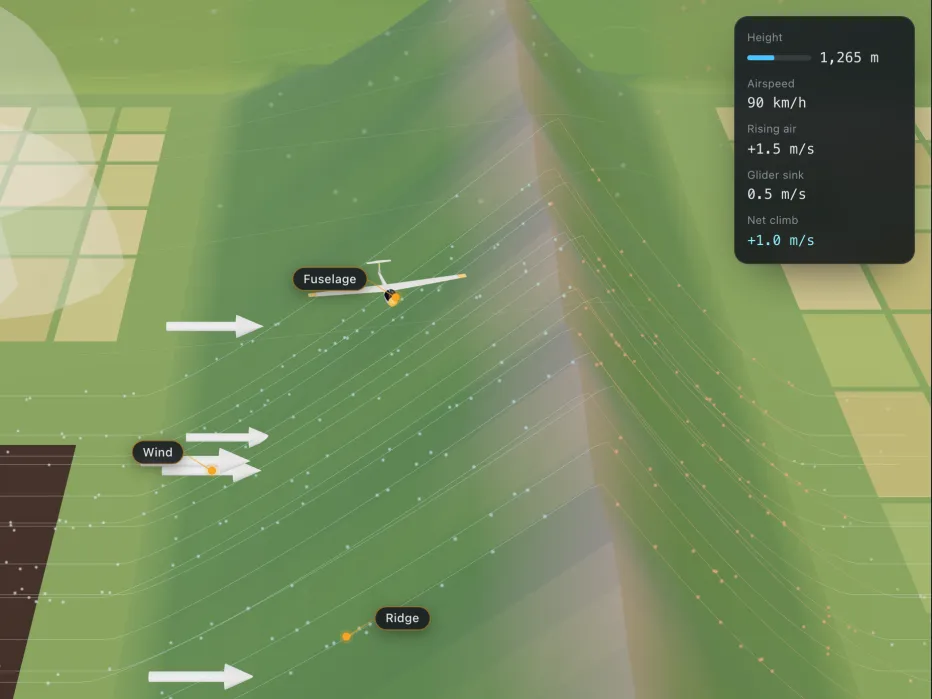
When wind meets a long ridge, it cannot pass through, so it is pushed up the slope that faces it. That band of rising air is ridge lift, and it carries on up above the crest. A long ridge works best. Around a single hill, the air mostly flows round the sides instead.
Our glider arrives just above the crest, which stands 1100 m above the valley floor. That is where the lift is best. It flies back and forth along the face at 90 km/h and always turns away from the slope at each end, never toward it. The air here rises at about 1.5 m/s, so the glider climbs at about 1 m/s, from 1150 m to 1400 m.
Ridge lift needs a steady wind of about 28 km/h or more, blowing within 30 to 45° of straight at the slope. Ours blows at 30 km/h. The lift can reach two to three times the height of the ridge. It needs no sun, only wind, so it keeps working into the evening, when thermals fade.
A long, straight ridge is a highway for gliders. Along the ridges of the Appalachians in the eastern United States, pilots have set world records flying out along the mountains and back again. Watch the air stream up the face in the scene, and the glider bank away from the slope at every turn.
06
Riding the mountain wave
Wind that crosses a mountain does not always settle down behind it. When the air is stable, it bobs up and down on the far side, like water flowing over a rock in a stream. The crests can be 3 to 30 km apart, and they stand still over the ground while the wind blows through them. This is mountain wave, and it can lift a glider far higher than any thermal.
Under the first crest lies the rotor, a band of rough, tumbling air, sometimes marked by a ragged rotor cloud. Above it the flow is smooth. At the top of a wave, a lens-shaped lenticular cloud can form. It stays in place, even though the wind blows straight through it.
Our glider moves from the ridge into the rising side of the wave and turns to face the wind. The wind grows stronger with height, and up here it blows about as fast as the glider flies, so the glider hangs over the same spot on the ground. The air rises at about 2.8 m/s, and the glider climbs at about 2.3 m/s, from 1400 m to 2500 m in eight minutes. That is a gentle wave. Wave lift of 1.5 to 6 m/s is common, and on 2 September 2018 the Perlan 2 glider rode waves over Argentina to 22,657 m (74,334 ft), the world altitude record for gliders.
Pilots who climb high in wave breathe from an oxygen bottle, because the air up there is thin. On the way home, our glider crosses the sinking side of the wave, where the air falls at about 2.5 m/s and the rising air readout drops below zero. In sinking air it pays to fly fast, so it races through at 200 km/h, drops to about 1560 m in four minutes, then glides calmly home across the valley.