
01
A tank of squeezed air
On 15 October 2026, Tesla showed its new Roadster at SpaceX's rocket test site in McGregor, Texas. The news called it a flying car. In fact it only made short hops, and nobody was aboard. Tesla says one version, the Rocket, carries ten cold-gas thrusters. These are air jets: they push the car by blowing out squeezed air, and they burn nothing. Tesla promises the car for 2028. Its own page says the Rocket is not approved for public roads.
The car on this page is a generic one, not Tesla's. It is a single-seat electric sports car of 1.7 tonnes, the weight Tesla aims for. The driver's seat is on the left. Where a second seat would be sits the air tank, and its tank valve lets the gas out to the nozzles. Reports say the real tank is filled to about 700 bar, which is 700 times the air pressure around you.
How big is the tank? Reports disagree: some say 400 L, others 600 L. So the model uses 600 L and lets you try 400 L. At 700 bar, air is packed tight: 100 L of tank space holds about 53 kg of it, so 600 L holds about 315 kg. Walls that hold this must be strong and light, so they are wound from carbon fibre. The hydrogen tanks of the first Toyota Mirai work at the same pressure. They weigh about 0.71 kg for every litre they hold. By that measure, a 600 L tank would weigh about 430 kg before any gas goes in.
Squeezed air stores energy, like a wound spring. As 100 L of it expands, it can do about 24 megajoules (MJ) of work, or 6.6 kilowatt hours (kWh). Tesla says a refill takes six or seven hours today, and it aims for 30 minutes. Drag the fill slider to see the least work a perfect pump would need, and how long that takes at 50 kW. Real pumps need more. The pressure on the slider follows the model's curve for air at room temperature. It climbs faster than the mass, because tightly packed air resists being squeezed further. Like every slider on this page, this one is a calculator: it shows the sums and leaves the 3D run alone.
On the day, Tesla ran three tests, with different cars: a timed sprint from 0 to 60 mph, a drive round a hook-shaped ramp, and a jump over parked vehicles. This page chains all three into one run of 23 seconds, played in real time unless a chapter slows it down. The motion is the model's own script. The gas and the tank you pick change the pressure, the jets and how much gas the run uses. The model treats the last 5 percent of the gas as unusable, because by then the pressure has collapsed. If a tank reaches that cut-off before a landing, your choice changes the landing speed too. It never changes the path.
- Empty tank, scaled from the Mirai
- 429 kg
- Toyota Mirai tanks
- 122.4 L, 87.5 kg, 5.0 kg of hydrogen
02
Throw gas back, go forward
Open a valve and the squeezed gas rushes out through a nozzle, a shaped opening that speeds it up. The gas shoots out one way, so the car is pushed the other way. That is Newton's third law: every push comes with an equal push back. The car has ten nozzles. Four rear nozzles push it forward, four corner nozzles point down, and two front nozzles swing the nose left or right.
The push is called thrust. It depends on two things. The mass flow is how many kilograms of gas leave each second. The exhaust speed is how fast that gas leaves. Thrust is the two multiplied together. Air from a 700 bar tank leaves at about 700 m/s. Engineers also rate a gas by its specific impulse, or Isp. It counts how many seconds a kilogram of gas could push with a force equal to its own weight. For cold air it is about 70 s.
You might think more pressure means faster gas. It mostly does not. The exhaust speed depends on the gas and its temperature. Pressure sets how much gas squeezes through the nozzle each second, and how much fits in the tank. Drag the pressure slider: the flow and the thrust fall with it, while the exhaust speed stays put.
As the gas expands, it cools far below freezing. That is where the white cloud in the gas jets comes from: some of the air may even turn into tiny drops, and moisture in the air around it freezes. They are called cold-gas thrusters because nothing heats the gas. Nothing burns, so there are no hot parts and only one valve per nozzle. The price is the weakest push per kilogram of any kind of thruster, because no fuel adds energy.
That simple, safe design is why spacecraft use it. Small satellites steer with cold-gas jets, and a Falcon 9 booster flips itself around with nitrogen jets near its top. The model keeps it simple too. It holds the exhaust speed fixed for each gas. In a real nozzle, air slows a little as the tank empties, to about 660 m/s at 300 bar. Tesla has not said how strong each nozzle is, so the model picks its own ratings.
03
The 0 to 60 test
The first test was a sprint. On the live run, Tesla says the car went from 0 to 60 mph (97 km/h) in 0.81 s. Nobody else timed it. A normal car speeds up through its wheels. Push too hard and the tyres spin, so grip sets the limit. The rear nozzles push on the car itself, not on the road. Tesla claims its thrusters make four to five times the force the tyres can.
Reaching 60 mph in 0.81 s takes an average acceleration of about 3.4 g. One g is the pull of gravity you feel when you stand still, so the push would feel like more than three times your weight. On a 1.7 tonne car, that takes a push of about 56 kilonewtons (kN). One kilonewton is roughly the weight of 100 kg. In the model, the four rear nozzles give all of it, about 14 kN each. The real car's motors help too, but the model counts their share as jet thrust. The car covers about 11 m before it reaches 60 mph.
Tesla's claim for the Rocket is faster still: under 0.59 s. That needs about 77 kN, close to the 80 kN Electrek reports for the rear jets. For the other versions, Tesla quotes under 1.6 s for the Performance, which has no thrusters, and under 0.9 s for the Thrust. But at 80 kN the jets use about 115 kg of air every second. A full 600 L tank would be empty in about 2.8 s.
After the sprint, the model does something of its own. It stops the jets and brakes from 60 mph, about 27 m/s, to 18 m/s, so the car reaches the hook at the speed the loop needs. This braking is the model's choice, not part of the real test. The model also holds each jet's thrust steady, though a real tank loses pressure as it empties and its jets weaken. Drag the thrust slider to see the push, the 0 to 60 mph time and the gas use. The run on screen keeps its own 56 kN.
- Rear thrust in the run
- about 56 kN, the model's figure for the 0.81 s run
- Tesla's 0 to 60 mph times
- 0.81 s on the live run, Tesla's figure; under 0.59 s claimed for the Rocket
04
The hook
The second test was the hook. The car reaches the ramp at about 18 m/s. The track curves up into a half loop about 5 m in radius, so the car climbs, goes vertical and comes over the top upside down. It runs onto a straight deck 16 m long, still upside down, 10 m above the ground. There it brakes to a stop and hangs under the deck for about three seconds. The real car did this too: in the test it stopped upside down on the ramp, held only by suction. Then the rear nozzles push it along the rest of the deck and off the end at about 7 m/s, upside down and heading back the way it came.
Going round the loop presses the car into the track. That push from the track is called the load. At the bottom of the curve the load is about 7.6 g: the track carries the car's weight and also bends its path hard at speed. Climbing costs speed, so the car comes over the top at about 11 m/s. That is still enough to press it into the track at about 1.6 g, even upside down, so the loop holds it on by itself.
At speed, the curve holds the car on. A stopped car has no speed to do that, so all the holding falls to the suction fans under it. Hanging still, the car's whole 1.7 tonnes pulls away from the deck, and the fans must pull back just as hard, with 1 g. Lars Moravy, who leads vehicle engineering at Tesla, says they can pull with up to 2 g, so they have room to spare. Electrek reports four fans of about 20 kW each. The model draws them as a blue glow and does not work out their pull.
Drag the entry speed slider to see how the loop changes. Below about 14 m/s, the car would not even reach the top. Like every slider on this page, it is a calculator: the run on screen keeps its own 18 m/s. Dropped from the deck with no help, the car would hit the ground in about 1.4 s. The ghost path shows where it falls, down to the landing pad. Tesla has not published the ramp's size, so the loop, the deck, the entry speed, the three-second hold and the 7 m/s push-off are the model's own. The chips above jump to the top of the loop, to the car hanging under the deck, or to the moment it leaves the ramp.
- Ramp
- a half loop of 5 m radius and a 16 m deck 10 m up, the model's ramp
- Fan pull
- up to 2 g of pull, Tesla's figure
05
Roll upright, then soften the fall
Upside down as it leaves the deck, the car must turn over before it lands. It falls freely for a tenth of a second, then the corner nozzles take over. They work like the small steering jets that turn a spacecraft in place. A push at one side of the car, away from its centre, makes it spin. How strongly that push turns the car is called torque. The two nozzles on one side fire first to start the roll, then the two on the other side fire to stop it, like a brake.
How fast the car turns depends on how hard it is to spin. This is its roll inertia, measured in kg·m². The more weight sits far from the centre, the harder it is to spin. Tests on real cars found about 390 kg·m² for a small car and 630 for a large one. Nobody has published a figure for a sports car with full tanks, so the model picks 600. The slider lets you try 500 to 900, while the run itself keeps 600.
In the run, each corner nozzle pushes with about 6 kN, 0.9 m from the centre, so a pair makes about 10.8 kN·m (kilonewton metres) of torque. At 600 kg·m², half a turn takes about 0.84 s: speed up for half, brake for half. These nozzle numbers are the model's own, not Tesla's.
By the time it is upright, the car has fallen about 4 m and drops at about 9 m/s. All four corner nozzles fire down at once, and the force arrows show their push. Together they give about 28 kN, more than the car's weight of 16.7 kN, so the fall slows. In about a second it is down to about 2.5 m/s, and the wheels touch the first landing pad. Tesla says its thrusters softened the landing too, but not how hard they pushed. So these catch numbers are the model's own.
After touchdown the car does not stop: it drives on toward the jump. The flip plays at half speed here so you can follow each pair of jets. Use the chips to jump to the moment the car is upright again or touches down, or press replay to watch the whole run again.
- Catch thrust
- 28 kN, 7 kN a nozzle, the model's catch
- Touchdown speed
- 2.5 m/s down
06
The jump
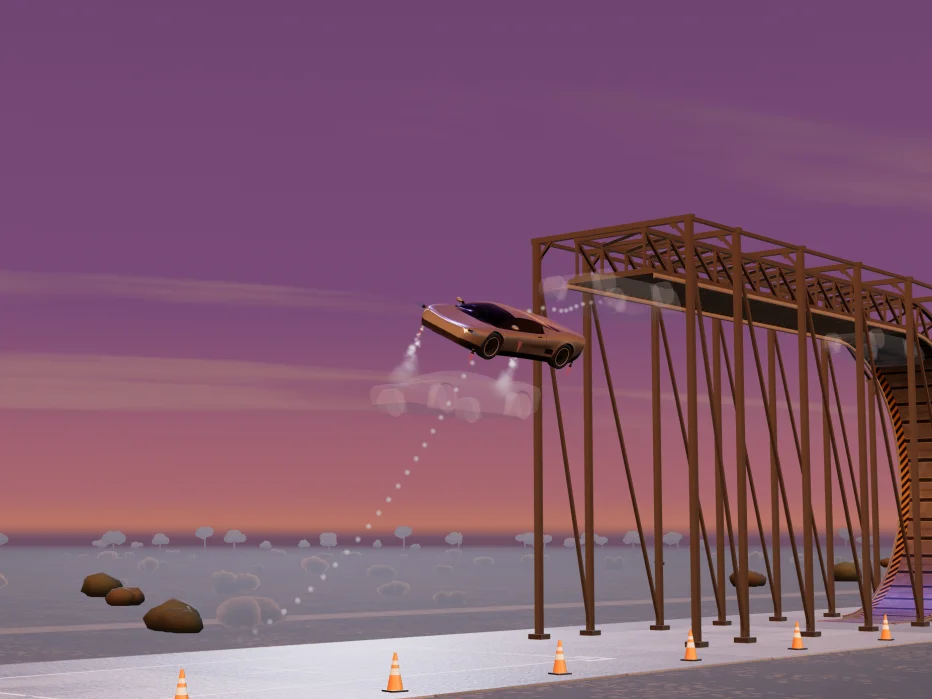
The third test was a jump over a row of parked vehicles. In the model, the car keeps going after its first landing. The rear nozzles fire again and take it from about 7 m/s to about 15 m/s. At the take-off point, all four corner nozzles fire down together.
They push with about 40 kN, more than twice the car's weight, for about 0.7 s. When they stop, the car is rising at about 9.6 m/s. From there it coasts up on an arc, like a thrown ball, and tops out about 8 m above the ground. Tesla gave about 8 m (27 ft) for its jump, though it is not clear whether that was height or length.
On the way over, the car twists through a full turn, 360 degrees. The same corner pairs that flipped it on the hook do this: one pair starts the roll, the other stops it. Below it pass a truck about 4 m tall and four cars, plain shapes in the model. As it comes down, the corner nozzles fire down again and cushion the landing to about 2.5 m/s. Then the car brakes to a stop.
Drag the height slider to see what a higher or lower jump costs: the upward speed it needs, how long the jets must fire, how much gas it uses, and how long and how far the car stays in the air. Like the other sliders, it is a calculator, so the run on screen keeps its 8 m. The row, the run-up speed and the length of the push are the model's own choices, because Tesla has not said how hard its thrusters pushed. The chips above jump to the take-off, the top of the jump or the landing.
- Parked row
- a truck and four cars over about 24 m, the model's row
- Tesla's jump
- about 8 m (27 ft), Tesla's figure
07
Why a hop is not a flight
To hover, the jets must push up with the car's whole weight, 16.7 kN for 1.7 tonnes. With air leaving at about 700 m/s, that takes about 24 kg of air every second. A full 600 L air tank holds about 315 kg. So even if every kilogram could be used, the car could hover for about 13 s at most. In practice it is less, because the pressure falls as the tank empties.
Why so short? Fast jets waste power. Holding the car up with air at 700 m/s takes about 5.8 megawatts (MW). An ideal helicopter rotor 10 m across holds the same weight by pushing a lot of air slowly, at about 9 m/s, and needs only about 0.16 MW. That is about 37 times less. A helicopter can stay up for hours on fuel; this tank lasts seconds.
So why not helium? It leaves about 2.6 times faster, at around 1,800 m/s. But helium is very light, so the same 600 L tank holds only 51 kg, a sixth of the air. What counts is the total push, called impulse: thrust times how long it lasts. Helium gives 93 kilonewton seconds (kN·s) against 220 kN·s for air, less than half. It wins only where weight matters more than space, as on a spacecraft.
Pick a gas and a tank with the chips, and watch how much gas is left. The model treats the last 5 percent of the gas as unusable, because by then the pressure has collapsed. That is its own cut-off. With air in the 600 L tank, the car finishes all three tests with about a fifth of its air left, so it never reaches the cut-off. Nitrogen in the same tank finishes with a little less. In the 400 L tank, the jump's landing gets no cushion at all, and the car comes down about 10 m/s harder: air runs dry during the twist, and nitrogen even earlier, during the take-off. Helium runs dry even sooner. In the 600 L tank that happens during the catch after the hook, and the car lands about 3 m/s harder. In the 400 L tank it happens as early as the flip, and the car lands about 11 m/s harder. The path stays the same whatever you pick; only the gas used, the pressure, the jets and the landing speed change.
Roger Conner, a curator of vertical flight at the Smithsonian's National Air and Space Museum, told CNN: "We are literally talking about hopping." The FAA told CBS the car does not meet its definition of an aircraft. So this is a car that hops for a few seconds, not one that flies.
- Gas flow to hover
- 23.9 kg/s
- Longest hover
- 13.2 s
- Jet power to hover
- 5.8 MW
- Total push
- 220 kN·s
- Gas the run uses
- 79 %
- Landing
- Soft landing at 2.5 m/s
- Ideal helicopter rotor
- about 0.16 MW for a 10 m rotor