
01
Push gas out the back, fly forward
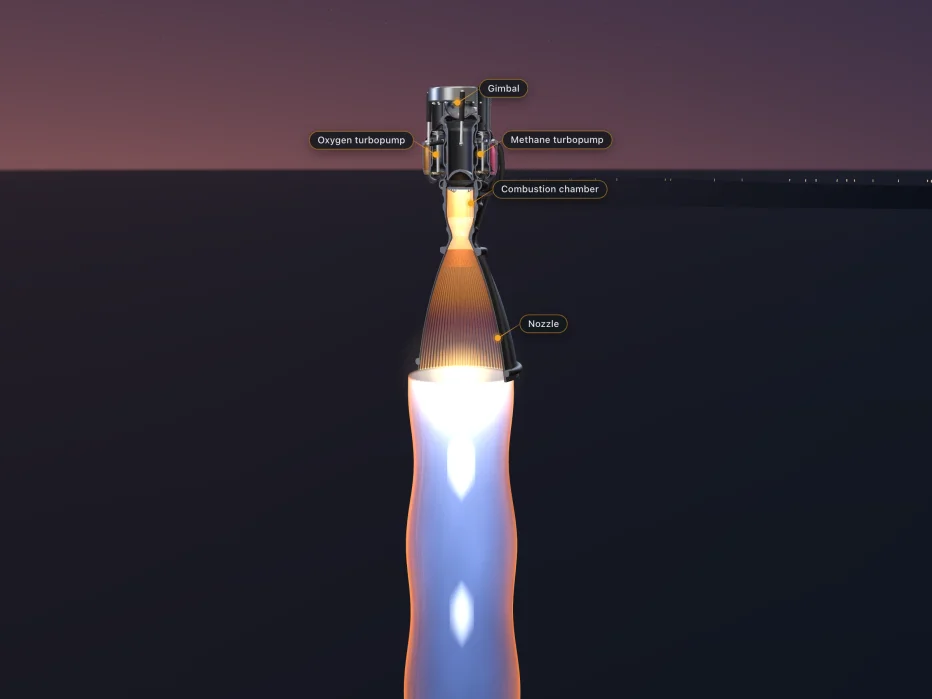
A rocket engine is simple at heart: it throws hot gas out of its back as fast as it can. Whenever you push something one way, it pushes you back the other way. You feel the same thing in the kick of a fire hose. That push back is called thrust. A rocket brings along everything it throws out, so it does not need any air to push against and works just as well in space. Raptor is the engine SpaceX builds for its Starship rocket. It burns liquid methane with liquid oxygen. The flame turns them into hot gas under huge pressure, and the bell at the bottom shoots that gas out at more than 3 km/s.
The engine in front of you is Raptor 3, the newest version. In flight it gives 250 tonnes of thrust, and SpaceX built it to reach 280. The engine itself weighs only 1,525 kg, so it pushes with about 160 times its own weight. It stands about 3.1 m tall and 1.3 m wide. Thirty-three of these engines fire together under the Super Heavy booster. Each one drinks about three quarters of a tonne of propellant every second, and the whole booster burns through about 25 tonnes a second.
This model follows one of the centre engines through a single launch burn, from the start command on the pad to the moment the booster engines shut down. A few things are simplified. SpaceX has never shown the inside of Raptor 3, so the cutaway draws the known cycle as a clear diagram rather than the real pipework. SpaceX has not published the throttle curve either, so the model works it out from the speed shown on the launch webcast. The start-up follows the usual order of steps. SpaceX says the whole start takes about 3 seconds, and the timing of each step within that is the model's own guess. The plume changes shape the way the real one does, only simpler. Drag the timeline to move through the launch, and drag the model to turn it around.
Every new version of Raptor has pushed harder and weighed less. Raptor 1 gave 185 tonnes of thrust and weighed 2,080 kg. Raptor 2 went up to 230 tonnes and down to 1,630 kg. Raptor 3 is built for 280 tonnes and weighs 1,525 kg. It also looks much cleaner from the outside, because it lost its heat shield. Earlier versions were wrapped in a shield that protected the pipes and wires running along the outside. On Raptor 3 most of that plumbing moved inside the engine's own parts, many of which are 3D printed. With nothing left to protect, the shield could go.
02
Two super-cold liquids
A car engine takes its oxygen from the air. A rocket climbs to where there is almost no air, so it has to bring its own. Raptor burns methane and oxygen. At room temperature both are gases, and a gas takes up far too much room to carry. So both fly as liquids, chilled below their boiling points. For methane that means 111 K, about −162 °C. For oxygen it is 90 K, about −183 °C. And the colder the liquid, the denser it gets, so more of it fits in the same tank.
The engine does not burn the two in equal amounts. For every kilogram of methane it burns about 3.6 kg of oxygen, so by weight the mixture is nearly four fifths oxygen. That is why the oxygen side of the engine is the bigger one, with the wider inlet and the larger pump. At full power a single engine swallows about 593 kg of oxygen and about 165 kg of methane every second. Moving that much liquid that fast takes serious pumps, and they are the subject of the next chapter.
Methane takes a detour before it burns. After its pump, most of it runs through many thin channels inside the walls of the nozzle and chamber. The cold liquid soaks up heat on the way, and that is what stops the metal from melting next to a flame of about 3,500 K. Engineers call this regenerative cooling. None of that heat is wasted, because it warms the methane on its way to the fire. Oxygen takes the short way, straight from its pump to its preburner. Tap a propellant to follow its route through the engine.
Some rocket makers, SpaceX among them, go one step further. They chill both liquids well below their boiling points, down toward freezing. This is called densifying, because a colder liquid shrinks a little and the same tank then holds more of it. Typically it squeezes about a tenth more propellant into a tank without making the rocket any bigger. There is not much room to play with, though. Methane freezes at about 91 K, only 20 degrees below where it boils. SpaceX has not said exactly how cold it loads Starship.
03
Two pumps, two small fires
Every second, Raptor has to force about three quarters of a tonne of propellant into a chamber where the pressure is over 300 bar. That is more than 300 times the air pressure around you. Tanks strong enough to push that hard on their own would weigh far too much, so pumps do the work instead. Each pump shares a shaft with a turbine, a wheel with blades that hot gas spins round. Together, pump and turbine make a turbopump. Raptor has two of them: a bigger one for oxygen and a smaller one for methane.
The turbines need hot gas to spin, and it comes from two small fires called preburners, one for each turbopump. Nearly all of the oxygen flows through the oxygen-rich preburner, where a little methane burns in it. The gas that comes out is hot but still mostly oxygen, and it spins the oxygen pump. The methane-rich preburner does the opposite: nearly all of the methane flows through it, a little oxygen burns in it, and its gas spins the methane pump. Both gases then flow on into the main chamber and finish burning there together. Nothing gets thrown away.
This design is called full-flow staged combustion, because every drop of both propellants passes through a turbine before it burns. That brings three big advantages. With so much gas available to drive them, the turbines can run cooler, at several hundred degrees rather than over 3,000, so they last longer. The pumps can push harder, which means higher pressure and more thrust from a smaller engine. And each shaft carries only one propellant, so there is no tricky seal that has to keep hot oxygen away from fuel. The scene shows the start-up in slow motion: first the pumps spin up, then the preburners light, then the main chamber. Tap an engine below to compare its cycle with Raptor's.
The hardest part to get right is the oxygen side. Hot gas that is mostly oxygen eats through most metals, and the oxygen turbine has to spin right inside it. SpaceX developed its own alloys to survive there, such as one it calls SX500. The idea of full flow itself is not new. The Soviet Union built and test-fired the RD-270 in the 1960s, and the United States tested the Integrated Powerhead Demonstrator in the mid-2000s. Neither ever left the ground. Raptor became the first full-flow engine to fly on 25 July 2019, when a single Raptor lifted the Starhopper test vehicle about 20 m into the air.
04
Where the big fire burns
The two hot gases meet at the main injector, a plate at the top of the combustion chamber. There they mix and burn at about 3,500 K, which is more than 3,200 °C. The pressure inside is over 300 bar, and in 2023 a Raptor 3 on the test stand reached a record 350 bar. The chamber itself is surprisingly small. Most of the engine's height is taken up by the pumps above it and the nozzle below.
Below the chamber the walls pinch inward to the throat, about 22 cm across, roughly the width of a dinner plate. All of the gas has to squeeze through this narrow neck, and it speeds up as it does. Right at the throat it reaches the speed of sound. Then the walls open out again into the nozzle, and the gas keeps on accelerating. By the time it leaves the engine it is moving at more than 3 km/s, about ten times the speed of sound in air.
This is the hottest place in the whole engine. The walls survive only because cold methane is racing through the channels inside them. The fire itself burns cleanly, because both propellants arrive already as gas. With gas meeting gas there are no drops of liquid that first have to break up and boil, so the two mix quickly and burn completely. The readouts below show what flows into the chamber each second and how fast the exhaust leaves.
How do you light a fire at over 300 bar? The two preburners are lit by small torch igniters, which Elon Musk has compared to heavy-duty spark plugs. The main chamber, though, has had no igniter at all since Raptor 2. The gases arriving from the preburners are so hot and so dense that they catch fire the moment they meet. Engineers say the two behave as if they were hypergolic, like propellants that burst into flame on contact. One part fewer is one less thing that can fail.
05
A bell for thick and thin air
The nozzle is the bell under the chamber. As the gas flows down through it, the bell widens, and the gas expands, cools and speeds up. In other words, the bell turns pressure and heat into speed, and speed is what makes thrust. But a bell can only be the perfect size for one air pressure. Make it too short and the gas leaves before it has given up all of its push. Make it too wide and the outside air pushes back in. Raptor's bell is sized for sea level, where the booster begins its climb.
At sea level, Raptor's exhaust leaves the bell at about 0.9 bar. The air around it is at about 1 bar, slightly higher, so the air squeezes the plume inward. Inside the squeezed jet, shock waves cross back and forth, and where they cross the gas heats up and glows. These bright spots are called shock diamonds. They stay in one place while the gas rushes through them, like the standing ripples in a fast stream.
As the rocket climbs, the air thins out and presses less on the plume. The plume spreads wide, and the diamonds stretch out and fade. At the same throttle setting the engine now pushes about 5 percent harder, roughly 14 tonnes more. Its specific impulse, a measure of how much push it gets from a given amount of propellant, climbs from about 330 s to about 350 s. By 30 km up, the engine has already gained nearly all of that. Drag the slider to see the engine at any height on the way up. The dip in thrust around max-Q comes from the engine throttling back, not from the air.
The ship on top of the booster also carries a version called Raptor Vacuum, or RVac, with a much wider bell. In space there is no air to squeeze the plume, so a bigger bell can expand the gas further and get about 380 s out of it. But RVac cannot run at full power at sea level. The thick air would push up into the bell and tear the flow away from the wall, and that shakes the nozzle sideways hard enough to damage it. So the booster flies with sea-level bells, and RVac waits for space.
06
Thirty-three engines, one launch
Super Heavy carries 33 Raptors arranged in three rings: 3 in the centre, 10 around them and 20 around the edge. The inner 13 do the steering. Each of them hangs from a gimbal, a joint at the top, and two actuators can tilt it by up to about 15 degrees. Tilting an engine tilts its push, and that turns the whole rocket. The outer 20 are fixed and cannot tilt. The engine in this model is one of the three in the centre.
The engines start about 3 seconds before liftoff. The rocket checks that every one of them is running properly, and only then, at T−0, do the hold-down clamps let go. The rocket picks up speed through the thick lower air. Somewhere between 45 and 60 seconds after liftoff comes max-Q, the moment when the air pushes hardest against the rocket. The engines throttle back for a while to ease the strain. SpaceX has not said by how much, so the curve here is the model's own reading of the webcast.
After max-Q the engines return to full throttle, and the thinning air adds its extra push on top. By about T+2:20 the booster is around 52 km up and travelling at about 5,800 km/h. Then its engines cut off, and the ship on top lights its own six engines while the two are still attached. This is called hot staging. Every Raptor 3 can relight in flight, so the booster can fire its engines again and fly back home. Tap a moment below to jump to it on the chart.
Raptor 3 flew for the first time on Flight 12, on 22 May 2026. So far the hard part has been relighting the engines in flight. On that flight, 20 of the 28 engines relit for the boostback, the burn that turns the booster back toward home, and only one relit for the landing burn. The start on the ground is watched just as closely. On 16 July 2026 the first attempt at Flight 13 shut itself down at T−0, because some engines had not come up to speed. The rocket stayed safely on the pad.