
01
You never touch the string
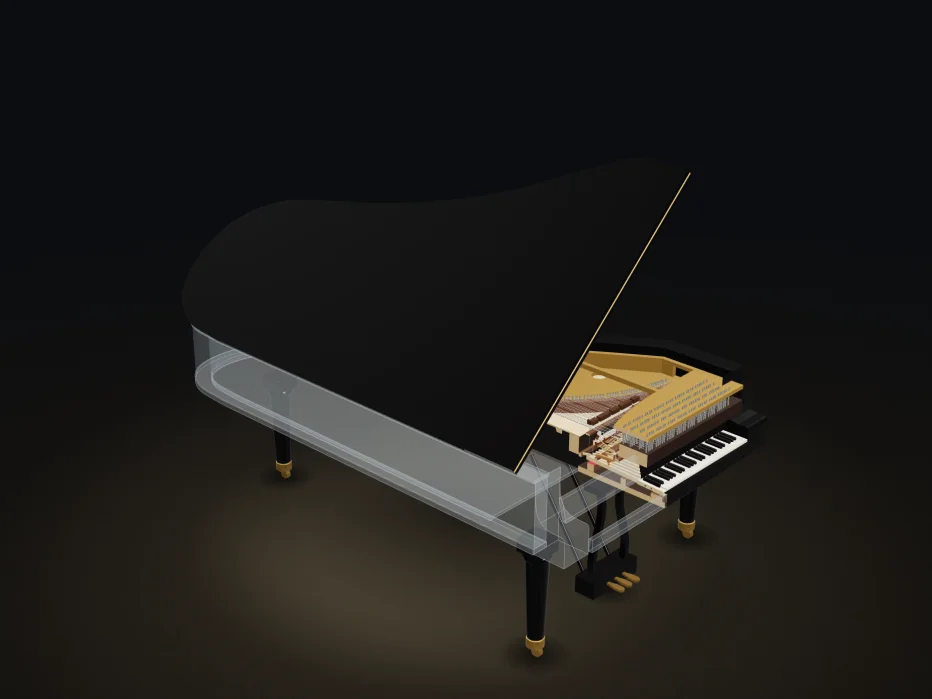
This is a concert grand, a Steinway model D. It is 274 cm long, weighs about 480 kg and has more than 12,000 parts. Under the open lid you can see the strings, the gold cast iron plate and, below them, the wooden soundboard. Its 88 keys play notes from 27.5 to 4,186 hertz (Hz), or vibrations per second. The model is cut open at middle C, near the centre of the keyboard, so you can watch one key at work.
Press a key and it goes down about 10 mm. Its back end rises and lifts the damper, a felt pad that keeps the strings quiet. Then a felt hammer swings up 45 to 47 mm and strikes the strings from below. The note rings until you let the key up and the damper drops back.
Here is the surprise: your finger never touches the string. The key is a lever that throws the hammer. For the last millimetre or two the hammer flies on its own, so nothing pushes it when it hits. At a medium touch it reaches the string about 67 milliseconds (ms), or thousandths of a second, after your finger meets the key. A hard press takes about 36 ms, and a soft one about 160 ms.
The playback is slowed down, and not evenly: the quickest moments are stretched the most so you can see them. The time readout on the gauge always shows the real clock. At the default playback speed, the ringing note lasts as long as it would on a real piano. Turn the sound on to hear it. It is not a recording: your browser builds the note from this model's numbers.
- Key press to strike
- about 67 ms
- Key travel
- about 10 mm
- Hammer to string at rest
- 45 to 47 mm
- Parts
- more than 12,000 in the whole piano
02
A lever that throws
The key is a seesaw. It rocks on a pin, so when you push the front down, the back end rises. There a screw called the capstan lifts the wippen, a hinged lever. The wippen carries the jack, a small L-shaped piece. The jack pushes up on the knuckle, a leather-covered roller under the hammer's handle, the shank.
The hammer swings up on a pivot, with its felt head about 130 mm out along the shank. Together these levers are called the action, and they multiply the key's movement. The hammer head travels about 5 to 6 times as far as the front of the key. It does so in the same time, so it also moves roughly that much faster. Turn on Follow the hammer to ride along with it.
At a medium touch the key reaches 0.3 to 0.5 metres per second (m/s), and the hammer about 1.5 to 2.5 m/s. A soft note sends the hammer up at about 1 m/s, a loud one at about 5 m/s, or 18 km/h. That loud hammer hits like something dropped from a tall person's shoulder. Pick a touch and watch the readouts change.
About 50 g resting on the front of a key is enough to start it moving. Playing takes more force: about 8 newtons (N) for a soft note and up to 50 N for a loud one, the weight of about 5 kg. In this model every lever is perfectly stiff, and the key always hits bottom just after the strike. A real action bends a little under a hard blow, and the order changes with loudness. In a soft note the hammer reaches the string first, but in a hard note the key hits bottom about 3 ms before the hammer strikes.
- Hammer travel
- about 5 to 6 times the key's travel
- Key speed at let-off, in this model
- 0.30 m/s
- Hammer speed at the string
- 1.7 m/s
- Hits like a fall from
- about 14 cm
03
Letting go
Just before the hammer reaches the string, the jack has to get out of its way. Its tail runs into the let-off button, a small stop above it. The jack tips, and its top slips out from under the knuckle. This release is called let-off, and the mechanism that makes it is the escapement. It happens 1 to 3 mm below the string, about the thickness of one or two euro coins. The let-off close-up shows this corner four times larger.
From there the hammer flies free. In this model the gap is 1.5 mm, so the flight lasts about 1.5 ms in a soft note and 0.3 ms in a loud one. At middle C the hammer then touches the string for about 2 ms, as brief as a camera shutter at 1/500 of a second. Nothing you do after let-off can change the blow: your touch only sets how fast the hammer is going at that moment. That speed decides how loud and how bright the note is.
After the strike the hammer bounces back down, and something has to catch it. The back check, a felt-covered block at the back of the key, holds it 13 to 16 mm below the string. A hard blow bounces back faster, so it is caught lower. As long as you hold the key down, the hammer waits there, clear of the string, and the note rings freely.
The repetition lever is what makes a grand quick. It springs up under the knuckle and holds the hammer partway up, so the jack can slip back under early. The key only has to rise about a third of the way before it can strike again. Makers say a grand key can repeat up to about 15 times a second, against about 7 on an upright. Bartolomeo Cristofori built the first escapement into his piano about 1700, and Érard patented this double escapement in 1821.
- Let-off gap
- 1 to 3 mm, 1.5 mm in this model
- Free flight
- 0.9 ms from let-off to string
- Caught by the back check
- about 15 mm below the string
- Repeats, maker's figures
- up to about 15 a second, against about 7 on an upright
04
Dampers and pedals
Most notes have a damper, a felt pad that rests on the strings and keeps them silent. Small lead weights hold it down. When you press a key, its back end lifts the damper before the hammer arrives. In one measured loud note, the damper left the strings about 15 ms before the strike.
In this model the damper lifts off after the first millimetre of key travel. That point is an assumption, because no source gives it for a grand. With a slower touch the rest of the stroke takes longer, so the damper lifts even earlier before the strike. When you let the key up, the damper drops back and the note stops. The top 18 to 21 notes have no dampers at all: pick Treble C7 and the note rings on after you let go.
The sustain pedal, on the right, lifts every damper at once. The note keeps ringing after you let the key go, and other strings start to ring along with it. In measurements on a Yamaha concert grand, middle C took 9.5 s to fade with the key held down and 15.3 s with the pedal. Turn on String vibration to see the other strings shimmer.
The left pedal, called una corda, slides the keyboard and the whole action a little to the right. Each hammer then hits two of its three strings, or one of two in the bass. The missed string still rings a little in sympathy, and the note comes out softer and duller. How far the action moves is not published, so the model shows the shift without a figure. On an upright the soft pedal works differently: it just moves the hammers closer to the strings.
- This note's damper
- On the strings
- Damper leaves the strings
- 40 ms before the strike, in this model
- Strings the hammer hits
- 3 of 3 strings
- Notes with no damper
- the top 18 to 21 notes
05
From string to room
A string is too thin to push much air on its own. Instead it presses on the bridge, a long wooden rail glued to the soundboard. The soundboard is a wide sheet of spruce, 6 to 9 mm thick, and it works like a loudspeaker. The vibration passes through the bridge into the board, and the board moves the air. String vibration is on here, so you can watch both move, greatly exaggerated.
A concert grand has about 230 strings, each pulling with 700 to 900 newtons, about the weight of an adult. Together that makes about 20 tonnes of force, roughly what ten cars weigh. A wooden frame could not hold that, so a cast iron plate, 160 to 180 kg on a concert grand, shares the load with the case. The wound bass strings are steel wrapped in copper, and they cross over the others. The copper adds weight, so a string sounds low without having to be very long.
A string vibrates at its main pitch and, at the same time, at a series of higher pitches called partials. On an ideal string they would sit at exactly 2, 3 or 4 times the main pitch, and so on. Steel wire is stiff, so each partial comes out a little higher, or sharp. The readout counts this in cents, hundredths of the step from one key to the next. Tuners stretch their octaves a little wider to match. In the deep bass the soundboard can barely send out the lowest pitches, below roughly 100 Hz, so you hear those notes mostly through their partials.
A struck note fades in two stages: a quick drop called the prompt sound, then a slow aftersound that can last many seconds. A faster hammer makes a louder, brighter note, because its felt hardens as it squashes and brings out more high partials. The decay readout is the time a note takes to fade by 60 decibels (dB). Those times come from a Yamaha concert grand, not this Steinway, and the C7 figures are this model's estimates. The pedal does not always help: in the measured bass note, the fade was slightly shorter with it. On the gauge, the sound level counts dB below a hard strike in this model, not loudness in the room.
- Note
- Middle C (C4), 261.6 Hz
- Strings for this note
- 3 steel strings
- Sharp partials
- partial 8 is 18 cents sharp
- Fade time
- about 9.5 s to fade by 60 dB
- String tension
- about 20 tonnes of force, all strings together
06
Upright and harpsichord
The line-up puts three actions side by side. On the grand, the hammer swings up from below and falls back by its own weight. The upright action comes from an upright piano, the tall kind that stands against a wall, and it is the same idea turned on its side. Its strings stand upright, so its hammer travels horizontally toward them. Springs and a thin tape called the bridle pull it back.
Most uprights also have no repetition lever, so the jack resets only when the key has risen almost all the way. Makers say an upright key repeats about 7 times a second, against up to about 15 on a grand. In this model the upright uses the grand's key and hammer distances, so you can compare the two fairly. Turn on the ghost upright action in any chapter to see it next to the grand's.
The harpsichord makes its note another way. Its key lifts a wooden strip, the harpsichord jack, and a small pick on the jack, the plectrum, plucks the string. However fast you press, the pluck stays the same, so your touch cannot make a note louder or softer. In Cristofori's day a harpsichord was louder and more brilliant than his piano, but it could not answer the player's touch. This model draws its jack in a simple form, not copied from a real instrument.
In 1711 the writer Scipione Maffei described Cristofori's instrument as a gravicembalo col piano, e forte, a harpsichord with soft and loud. Soft and loud, piano and forte in Italian, were exactly what a harpsichord's keys could not give. The clavichord, another early keyboard, could, but it was so quiet that you could barely hear it a few feet away. Pick an instrument below to compare the three.
- How the string is played
- struck from below by a felt hammer
- How the hammer returns
- falls back by its own weight
- Touch
- sets loudness and brightness