
01
Eight beats a second, from a coiled spring
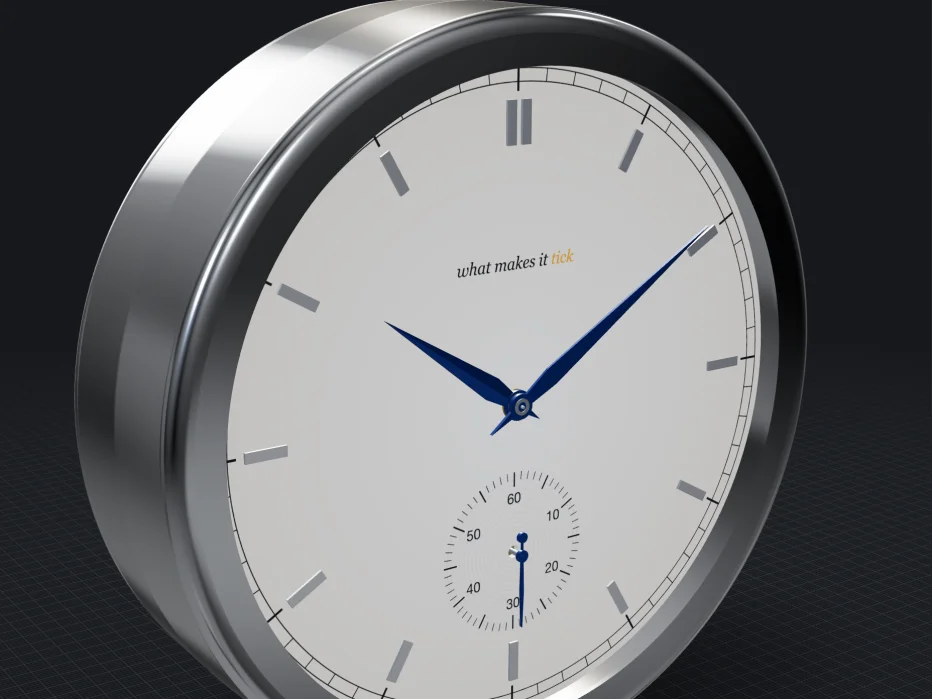
You are looking at a mechanical watch, standing on its edge as if on a display stand. The case holds a dial, three hands and a crown on the side for winding. The real work happens behind the dial, in the part watchmakers call the movement. It has no battery and no chip. Everything runs on a coiled steel spring, a chain of small wheels and a tiny wheel that swings back and forth.
The movement does three jobs. First, it stores energy: turning the crown winds up the mainspring. Then it lets that energy out in small, even steps. That is the work of the escapement and the balance. Finally, it counts the steps and shows them as time, using a train of wheels and the hands. The energy path view traces the power from the spring through the wheels to the balance. Each chapter below looks at one of these parts in turn.
The wheels of a mechanical watch move in small steps. The balance lets the escape wheel go half a tooth at a time, and every other wheel follows. Each release is one beat, and you hear it as a tick or a tock. This watch makes 28,800 beats an hour: 8 every second, 691,200 a day. The balance swings back and forth 4 times a second. Each full swing takes 250 ms and has two beats: a tick as it passes the centre one way, and a tock as it comes back. The timeline under the model follows one full swing.
The numbers in these chapters come from a hand-wound movement like the ETA 2801-2, which you wind by turning the crown. It is 25.6 mm across and 3.35 mm thick, with 17 jewels. The model follows a textbook layout of the same kind. It pulls the layers apart so you can see each one. Drag the model to turn it and look at the dial side. In real time the balance is a blur, so slow the playback down and watch it swing.
02
Forty-two hours in a coil of steel
The energy is stored in the mainspring, a long steel strip coiled up inside a drum called the barrel. Turning the crown turns the stem, and small pinions pass the motion on to the crown wheel and the ratchet wheel. The ratchet wheel sits on the arbor at the centre of the barrel. The arbor winds the inner end of the spring tighter while the barrel stands still. A little click drops into the ratchet's teeth as they pass, so the spring cannot turn the arbor back.
Stretched out, this spring is 420 mm long, yet only 0.125 mm thick and 1.23 mm high. Its turning force, the torque, is about 11.3 mN·m when fully wound. A day later it has dropped to about 9.1 mN·m, some 19 percent less. So the push that drives the watch is never quite constant. A full wind stores about a third of a joule, and the watch spends it slowly, at about 2 to 3 microwatts.
As the spring unwinds, it turns the barrel, and the teeth around the barrel's rim drive the wheels. One full wind keeps this movement running for 42 hours. This is its power reserve. In the model's textbook gearing, the barrel turns once every 8 hours. So a full wind is about five and a quarter turns of the spring. Drag the slider toward empty: the coil creeps out to the barrel wall, the torque drops and the balance's swing shrinks.
In a hand-wound watch, the click holds the spring. When the spring is fully wound, the crown simply stops turning. An automatic watch is wound by a swinging weight that cannot tell when to stop. So its spring ends in a slipping bridle, which slides around the barrel wall instead of overwinding. The automatic version of this movement, the ETA 2824-2, is 4.6 mm thick instead of 3.35 mm and runs for 38 hours. Wind the model fully to start again.
03
Gearing up, not down
From the barrel, the power runs through a chain of wheels called the going train. Each wheel is large and drives a small pinion on the next arbor, so every step turns faster than the one before. The spring is slow and strong, but the escapement needs quick, light motion. So the train gears up, not down. At the end of the train, the barrel's slow creep has become 12 turns a minute at the escape wheel.
Watchmakers call a small driven gear a pinion, and they call its teeth leaves. The model uses a textbook train. The barrel's 80 teeth drive a pinion of 10 leaves, which makes it turn 8 times faster. The next steps multiply the speed by 8, 7.5 and 12. So the centre wheel turns once an hour, the fourth wheel once a minute and the escape wheel 12 times a minute. Each of its 20 teeth gives two beats: 12 × 20 × 2 makes 480 beats a minute, or 28,800 an hour.
In this textbook layout, the centre wheel sits in the middle of the movement and turns once an hour, so it carries the minute hand. The fourth wheel turns once a minute and carries the small seconds hand at six o'clock. The escape wheel averages 12 turns a minute, yet it stands still most of the time. It moves in short jumps of 9°, one per beat. Pick a wheel below and the camera will follow it.
The pivots of the wheels turn in jewels: tiny bearings of synthetic ruby, made in a factory. They are not gems. A steel pivot turning in ruby has only a fraction of the friction of metal on metal, and it is oiled too. This movement has 17 jewels. Its automatic sister has 25, but the extra 8 sit in the winding works and do nothing for timekeeping. So more jewels do not mean a better watch. The amber dots trace the power from the barrel to the balance.
04
Letting go half a tooth at a time
The spring pushes on the escape wheel all the time. Left alone, the wheel would spin away in a moment. The pallet fork holds it back. Two ruby stones on the fork, the entry and exit pallets, reach over two and a half teeth. Between beats, one of them blocks a tooth. Its locking face sits at a slant, called draw. Because of this slant, the tooth's pressure pulls the fork in and holds it against a banking pin. The wheel is locked.
Then the balance swings back. A ruby pin on its roller, called the impulse jewel, enters the slot in the fork. It nudges the fork until the stone slides off the tooth, and the wheel is unlocked. The tooth now slides along the sloped end of the stone and kicks the fork, which kicks the pin in turn. That push is the impulse. The club-shaped tooth and the stone both have sloped faces, and they share the push. After that, the wheel drops free until the next tooth locks on the other stone. It has turned 9°. Step through it with the buttons below.
The pin touches the fork only during the 50° of swing around the centre, called the lift angle. When the balance swings about 280° each way, that contact lasts about 7 ms of each 125 ms beat. For about 94 percent of the time, the balance swings free, and draw keeps the fork parked on its banking pin. That is why this is called a detached escapement. If a knock tries to move the fork while the pin is away, a guard pin on the fork hits the safety roller and stops it.
The tick you hear is not one sound but three quick impacts. First, the pin strikes the fork. Then a tooth lands on the sloped face of a stone. The loudest comes last: a tooth locks as the fork hits its banking pin. The tock is the same on the way back. Thomas Mudge invented this lever escapement in the 1750s. Since about 1900, almost every mechanical watch has used one. Drag the timeline slowly through the tick and watch the wheel wait, jump and stop.
05
The wheel that decides how long a second lasts
The balance is a ring 10.6 mm across that turns back and forth on pivots just 0.08 mm thick. A spiral hairspring always pulls it back toward the centre. The balance overshoots and swings the other way, like a child on a swing. Only two things set how long a swing takes. One is the rim: how heavy it is and how far out its weight sits. The other is how stiff the spring is. More weight far out makes the swing slower, and a stiffer spring makes it faster. Here one full swing takes 250 ms. Christiaan Huygens designed a spiral balance spring in 1675.
How far the balance swings is called its amplitude. When the watch is wound, it is about 280° each way, so more than a full turn from one side to the other. Sellita, which builds movements on the same design, allows at most 315° at full wind and at least 200° a day later. Above about 335°, the impulse jewel would swing right round and knock the back of the fork. The balance carries about 12 µJ of energy, and each beat tops up only a few percent of it.
To set the rate, a watchmaker moves the regulator index. Its two tiny stops, a curb pin and a boot, hold the outer coil of the hairspring. They set how much of the spring is free to flex. Shorten that working length and the watch runs faster; lengthen it and the watch slows down. Small changes matter: a hairspring just 1 percent stiffer would make the watch gain about 7 minutes a day. Nudge the slider and see how little it takes to throw the watch off by minutes a day.
Heat, magnetism and knocks all disturb the balance. Hairsprings made of Nivarox, an alloy developed for them in the 1930s, hardly change with temperature. Silicon hairsprings are not magnetic. To survive knocks, the jewels that hold the balance pivots sit in a shock setting. A spring lets the jewel shift, the thick shoulder of the staff takes the blow, and then the spring centres the pivot again. Incabloc, from the early 1930s, is one such setting. In this movement family, only the better grades get it. The others use ETA's own Etachocs.
06
From beats to hours
Now look at the dial side. Under the dial, a small set of gears called the motion works makes the hour hand turn once while the minute hand turns twelve times. In this textbook layout, the cannon pinion has 10 leaves and drives the 30-tooth minute wheel. The minute wheel's 8-leaf pinion then drives the 32-tooth hour wheel. That gives 3 times 4, or 12 to 1. The cannon pinion grips by friction only, so when you set the time, the hands turn while the train stays still.
The fourth wheel carries the small seconds hand at six o'clock. It moves 6° a second, not smoothly but in 8 tiny steps, one for each beat. The steps are so small and quick that the seconds hand of a mechanical watch seems to glide. The ETA 2801-2 itself is built differently. Its seconds wheel sits in the centre of the movement and drives a centre seconds hand. The minute hand rides on a tube around it.
Not every watch beats 8 times a second. Before the 1970s, 18,000 beats an hour was usual, and 21,600 is common today. Grand Seiko reached 36,000 in 1968, and Zenith's El Primero followed in 1969. A faster beat rate keeps timekeeping steadier when the watch is knocked or changes position. The cost is energy. With the same balance and the same swing, its energy grows with the square of the frequency. So the spring runs down sooner, or the parts wear faster. Switch between the rates and compare the numbers below.
How accurate is accurate? A certified chronometer must average between −4 and +6 seconds a day in COSC's tests. That is one of seven criteria, checked on the bare movement over 15 days, in 5 positions and at 3 temperatures. METAS tests the cased watch, even after exposing it to a magnetic field of 15,000 gauss. It allows 0 to +5 seconds a day, or 0 to +6 for a movement this size. For quartz, COSC's limit is about ±0.07 seconds a day. Yet in 2025, Switzerland exported 5.2 million mechanical watches, worth 86 percent of all its watch exports.