
01
A machine that makes its own light
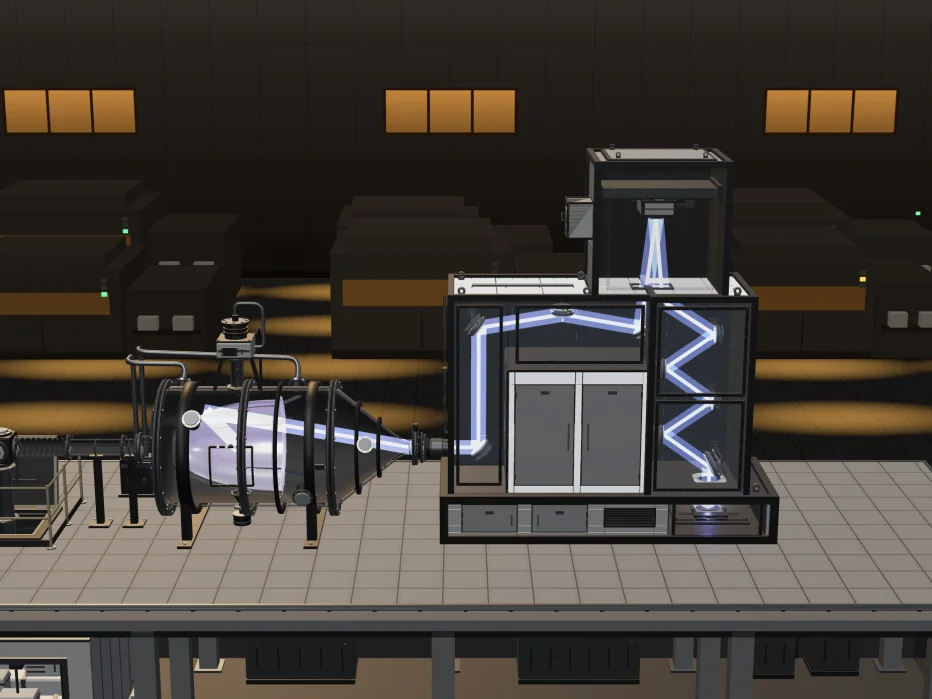
This machine prints the finest layers of the most advanced computer chips. It is huge. The newest model is called High-NA. It weighs more than 150 tonnes and shipped in more than 250 crates, 43 containers and 20 trucks. NA is short for numerical aperture, which says how wide a cone of light the last mirror collects. The last chapter explains why that matters. No maker publishes how long or tall the machine is, so every size and position in this model is our own.
The machine prints with extreme ultraviolet light, or EUV. You cannot see it. Its wavelength, the length of one wave, is only 13.5 nm. A nanometre (nm) is a millionth of a millimetre. Air and glass swallow this light. 1 mm of air lets through about 0.14 percent, and 1 µm of glass about 0.004 percent. So there are no lenses in this machine. Every part that steers the light is a mirror, and the light travels in a near-vacuum with a little hydrogen.
The machine makes its own light, one flash at a time, from a tiny drop of tin. A drive laser sits on the floor below. Its beam climbs through a long beam path, up to 30 m, to the source vessel. The laser delivers tens of kilowatts and weighs more than 10 tonnes.
The wafer is a thin round slice of silicon. It goes in, the machine prints it one patch at a time, and it comes out. This page follows one flash instead, from the tin drop to the wafer. The model is a simplification. Nobody can see a beam in a vacuum, and EUV is not visible at all, so we chose the beam colours. The clock is the model's own too. A drop flies for about 20 ms, but the flash lasts about 20 ns, so playback stretches and squeezes time.
- Weight, High-NA
- more than 150 t
- Shipping
- more than 250 crates, 43 containers, 20 trucks
- Sizes in this model
- every size here is the model's own
02
A droplet, hit twice
Every flash starts with a drop of tin about 30 µm wide. That is a bit more than half the width of a human hair. A hair is about 50 µm, a rounded figure. The droplets are fired, not dropped, at 60 to 120 metres a second. About 50,000 of them go by each second, roughly 1.2 to 2.4 mm apart. The makers do not say which way the drops fly, so the model picks a direction.
A laser hits each drop twice. The first, gentler pulse flattens it into a thin pancake more than 100 µm wide. A flat target takes the next pulse much better than a ball. The second pulse is the big one. It comes from a CO2 laser whose light is 10.6 µm long, and it starts as a small seed pulse that is boosted more than 10,000 times. Two pulses for each drop make about 100,000 laser pulses a second.
The big pulse heats the tin to about 220,000 °C, 30 to 40 times hotter than the surface of the Sun. The tin turns into plasma, a gas so hot that its atoms lose electrons and glow. Tin ions in the plasma give off light at 13.5 nm. That is why this machine uses tin. Small drops also leave little debris. Only about 5 percent of the laser light becomes EUV, and that figure is from the lab.
The collector mirror, a big curved mirror, catches the light and gathers it into one spot. The vessel holds low-pressure hydrogen. It stops tin specks and cleans tin off the mirror. A collector has been shown to last more than 100 billion pulses.
- Droplet size
- about 20 to 30 µm
- Droplet speed
- 60 to 120 m/s
- Gap between droplets
- about 1.2 to 2.4 mm
- Laser pulses
- about 100,000 laser pulses a second
- Flattened target
- more than 100 µm wide
- Plasma heat
- about 220,000 °C, 30 to 40 times the Sun's surface
- Light that becomes EUV
- about 5 percent of the laser light, in the lab
03
Light that only bounces
EUV mirrors are not shiny metal. Each one is a multilayer mirror: more than 100 thin layers of silicon and molybdenum, each a few nm thick. Every boundary between layers reflects a little light. The layers sit about 6.8 to 6.9 nm apart, half the wavelength, so the small reflections add up instead of cancelling.
Even so, a mirror gives back only about 70 percent of the light. That is the best measured, not a promise. So the light loses about a third at every bounce. The model counts 11 bounces from the intermediate focus (explained below) to the wafer: four mirrors that shape the beam, the mask, and six mirrors that shrink the pattern. About 2 percent of the light reaches the wafer, and the range is 1 to 4 percent. The count rests on one paper, and another counts 10.
These mirrors must be extremely smooth. Their roughness is about 50 pm, and a picometre (pm) is a thousandth of a nanometre. Zeiss, which makes them, says that on a mirror as wide as Germany the highest bump would be only about 0.1 mm.
The collector gathers the light at one point, the intermediate focus, and the beam spreads out again from there. Use the slider to follow the beam bounce by bounce, and watch how much light is left. The model draws the folds and positions of the mirrors itself, following published diagrams.
- Layers in a mirror
- more than 100 layers, each a few nm thick
- Light given back per mirror
- about 70 percent
- Roughness
- about 50 pm
- Why no lenses
- 1 mm of air passes about 0.14 percent, 1 µm of glass 0.004 percent
04
A mirror with a map on it
The mask, also called the reticle, holds the pattern of one chip layer. It is a mirror too. A thin layer on top, the absorber, soaks up the light wherever the pattern has a line, so the light that bounces off carries the pattern. The mask sits on a square plate, 152 mm wide (six inches), and the pattern area is 104 by 132 mm.
Before the mask comes the illuminator, four mirrors that shape the beam. Their surfaces are made of many small tiles, called facets, that can be tilted. The tilts set the angles at which light reaches the mask. One study measured 22 such settings on a single illuminator, an approximate figure.
The beam meets the mask at a slant of 6 degrees (5.4 on High-NA). So the light going in and the light coming out are 12 degrees apart, and the two beams do not collide. In this model the mask faces down. That placement is our own choice.
A pellicle covers the mask. It is a very thin film that keeps dust off, because a speck on the mask would print on every wafer. The light crosses it twice, in and out. More than 90 percent passes each time, and about 81 percent passes both times. A pellicle is a film, not a lens. After the mask, the projection mirrors shrink the pattern 4 times (8 times in one direction on High-NA).
- Mask plate
- 152 mm square plate
- Pattern area
- 104 by 132 mm
- Beam slant
- 6 degrees; in and out 12 degrees apart
- Light through the pellicle
- above 90 percent a pass, about 81 percent in and out
- Shrink from mask to wafer
- 4×
05
A field at a time
A wafer holds many copies of a chip, and the machine prints one patch at a time. Each patch is a field, 26 by 33 mm. A wafer holds about 76 to 80 full fields. The light does not cover a whole field at once. It passes through a curved slit, about 26 by 2 mm.
To cover a field, the mask and the wafer move together in opposite directions. The slit sweeps over the mask, and the shrunk pattern sweeps over the wafer. This is called scanning. A machine can scan 160 wafers an hour (NXE:3600D) or up to 220 (NXE:3800E). Those are the makers' specs, for a light dose of 30 mJ/cm2, the energy that lands on each square centimetre.
A photon is one particle of light. That dose is about 20 EUV photons on every square nm of the wafer. The moves must be very exact. Position sensors tell where things are to about 60 pm, 20,000 times a second. Overlay is how well one layer lines up with the layer below. From machine to machine it is 1.1 nm on the 3600D, 0.9 nm on the 3800E and 1.1 nm on the High-NA EXE:5000.
In the last stretch of the playback, the clock shows how far the scan of one field has got. In this model one field takes about 0.29 s at 160 wafers an hour and 0.21 s at 220. These times are approximate. A real exposure is shorter, because the time per wafer also includes loading and aligning. Pick a machine to see the numbers change.
- Wafers an hour
- 160 wafers an hour
- Time for one wafer
- about 22.5 s a wafer, with loading and aligning
- Time for one field
- about 0.29 s a field in this model
- Fields on a wafer
- about 76 to 80 full fields
- Slit
- 26 by 2 mm slit
- Position sensing
- about 60 pm, 20,000 times a second
- Layer alignment
- 1.1 nm, machine to machine
06
193 nm against 13.5 nm
Older machines use deep ultraviolet light, or DUV, with a wavelength of 193 nm. They use lenses, with a layer of water under the last lens. The size of a line is given as a half pitch: half the distance from one line to the next. DUV prints a half pitch of about 36 to 38 nm. EUV prints 13 nm lines with 13 nm gaps, so the full pitch is 26 nm.
EUV light has a much shorter wavelength. Each photon also carries 91.8 eV of energy (electronvolts, a unit of energy), about 14 times a DUV photon. Shorter waves can draw finer detail. The smallest line follows a simple rule: k1 times the wavelength, divided by the NA. The number k1 depends on how well the process is tuned, and a lower k1 is harder to reach. The NA is the cone of light the last mirror collects, from the first chapter. A wider cone sees finer detail. With k1 at 0.3, the rule gives 12.3 nm at an NA of 0.33 and 7.4 nm at 0.55.
The High-NA machine has an NA of 0.55. It shrinks the pattern 4 times in one direction and 8 times in the other, so one field is half as big, 26 by 16.5 mm. It prints an 8 nm half pitch. The real mirror count of High-NA is not known. So this model keeps the same mirror path and changes only the last mirrors, the shrink, the field and the numbers. The projection mirrors weigh about 12 tonnes and the illuminator mirrors about 6.
To feel the scale, a flu virus is about 100 nm wide. About 8 of these lines fit across it. A hair is wide enough for thousands. The "3 nm" in chip names is only a name. The finest wires are really about 23 to 24 nm apart. ASML does not publish a price. Press reports say a machine costs well over 100 million euros, and a High-NA one about 350 million.
- Shrink from mask to wafer
- 4×
- Field
- 26 by 33 mm
- Smallest line (half pitch)
- 13 nm wide, 13 nm apart
- Older DUV machines
- 193 nm light, about 36 to 38 nm lines
- Energy of one photon
- 91.8 eV, about 14 times a 193 nm photon
- Price
- over 100 million euros, High-NA about 350 million